
Mastering the Art of Progressive Muscle Relaxation
Why the Progressive Muscle Relaxation Technique Belongs in Every Man’s Stress Toolkit
The progressive muscle relaxation technique is a simple, research-backed method where you systematically tense and then release muscle groups throughout your body — moving from your feet up to your face — to trigger deep physical and mental relaxation.
How it works in brief:
- Find a quiet, comfortable spot and take a few slow, deep breaths
- Tense one muscle group (e.g. your feet) for about 5 seconds while inhaling
- Release the tension all at once while exhaling, and rest for 10-20 seconds
- Notice the contrast between tension and relaxation
- Move up through your body — calves, thighs, abdomen, chest, arms, shoulders, face
- The full session takes around 10-20 minutes
You’re busy. Your schedule is packed. And by the end of the day, your shoulders are practically touching your ears.
That constant low-level tension isn’t just uncomfortable — it’s a signal. Your body is stuck in stress mode, and your muscles are carrying the load.
Here’s the thing: your body and mind are deeply connected. When your muscles are chronically tight, they send stress signals right back to your brain, keeping you in a loop of tension and anxiety. It works the other way too — physically relaxing your muscles can actually calm your mind.
That’s the core idea behind progressive muscle relaxation (PMR). It was developed nearly a century ago, and the science still holds up today. A 2020 study on 80 burn patients found that just 20-30 minutes of daily PMR over three days significantly reduced anxiety and improved sleep quality. No equipment. No medication. Just your body and your breath.
For a busy guy trying to stay sharp, sleep better, and keep stress from derailing his health goals — this technique is worth knowing.
What is the Progressive Muscle Relaxation Technique?
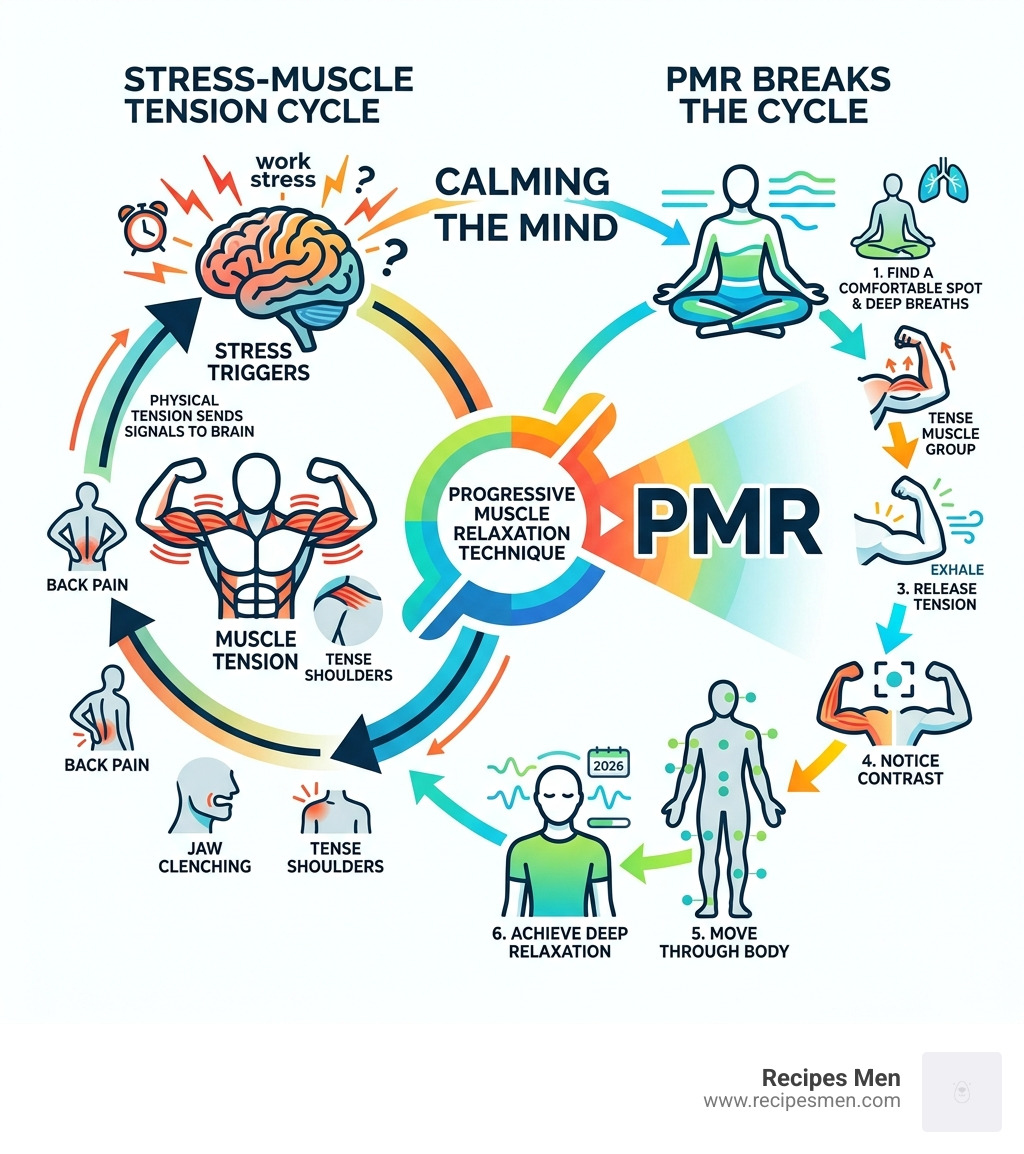
At its heart, the progressive muscle relaxation technique is a two-step behavioral therapy designed to help us recognize the difference between the sensation of a tensed muscle and a completely relaxed one. Most of us walk around with “hidden” tension; we don’t realize our jaws are clenched or our lower backs are tight until the pain becomes impossible to ignore.
PMR changes that. By deliberately creating tension and then letting it go, we train our nervous system to shut down the “fight or flight” response and engage the “rest and digest” system. It is often referred to as Progressive Muscle Relaxation Overview because it provides a systematic roadmap for total body calm.
The History of Jacobson’s Relaxation
We owe this technique to Dr. Edmund Jacobson, an American physician and psychologist who began his research in the early 1920s. Jacobson noticed that his patients’ physical tension was directly linked to their mental state. He theorized that since the muscle-mind connection is a two-way street, a person who is physically relaxed cannot feel anxious.
In 1938, he published his seminal work, Progressive Relaxation, which detailed a method of tensing and releasing 14 different muscle groups. While modern versions are often shorter and more streamlined, the core principle remains the same: neuromuscular relaxation is the key to psychological peace. Over the decades, clinical psychology has embraced “Jacobson’s relaxation” as a foundational tool for treating everything from high blood pressure to chronic anxiety.
How the Progressive Muscle Relaxation Technique Works
The progressive muscle relaxation technique works by interrupting the loop of physiological tension. When we are stressed, our muscles tighten automatically. This is a survival mechanism. However, in April 2026, most of our “threats” are deadlines and traffic, not saber-toothed tigers. Our bodies don’t always know how to switch the tension off.
By isolating specific muscle groups—like the biceps or the calves—and contracting them for a few seconds, we “load” the muscle. When we suddenly release that contraction, the muscle is forced into a state of deeper relaxation than it was in before the tension began. This sends a powerful signal to the brain that the danger has passed, triggering a systemic relaxation response across the entire nervous system.
Science-Backed Benefits for Men’s Health
For the modern man, PMR isn’t just “meditation-lite”—it’s a performance-enhancing recovery tool. Whether you are dealing with the pressures of career growth or the physical toll of a heavy lifting session, PMR offers measurable benefits.
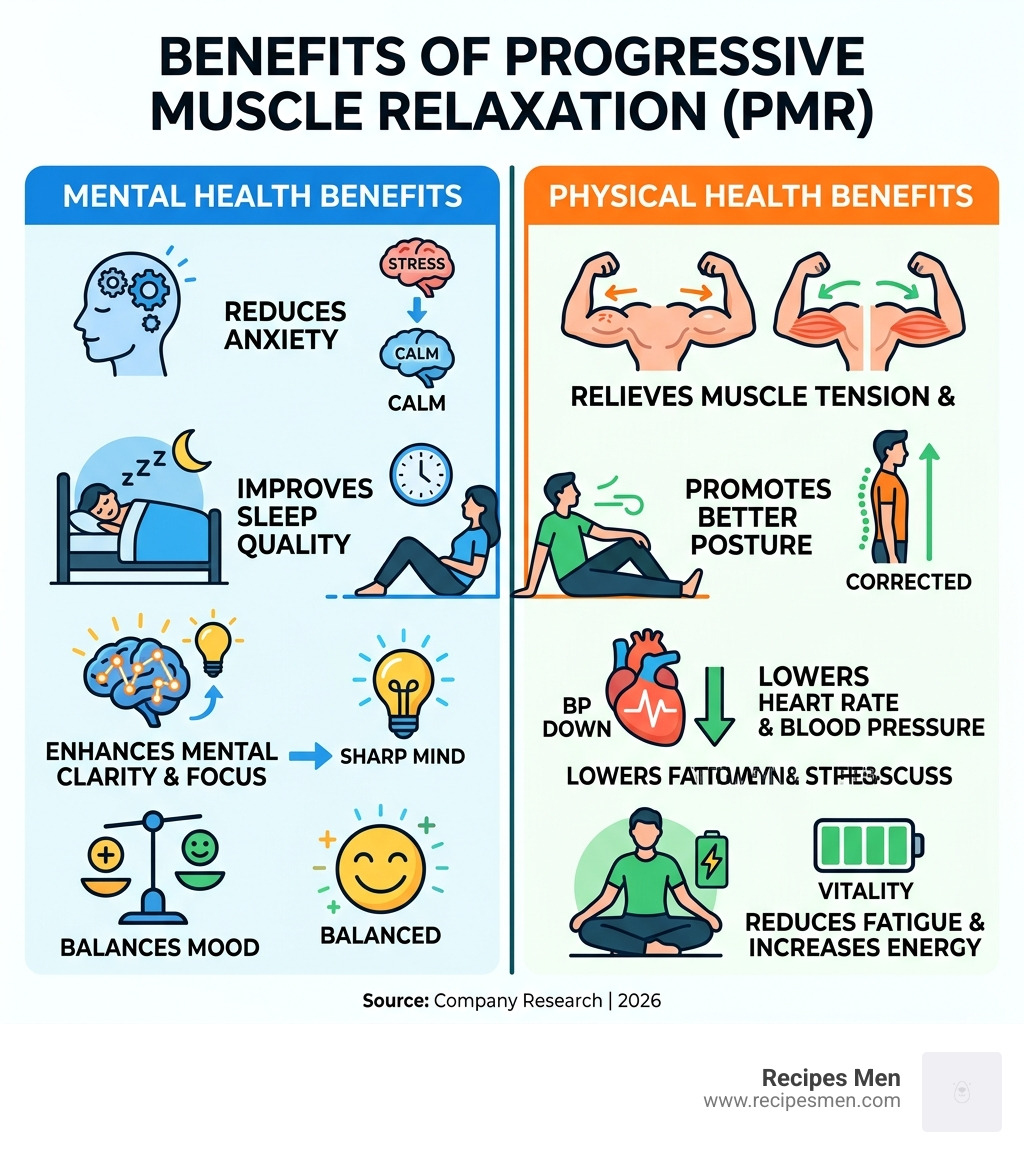
Scientific research consistently supports PMR for Stress & Insomnia. A landmark 1999 review by the American Academy of Sleep Medicine even rated it as an effective nonpharmacologic treatment for chronic insomnia. More recently, a 2020 study involving 80 patients showed that practicing PMR for just 20-30 minutes daily for three days led to a significant decrease in anxiety and a massive improvement in sleep quality.
Why the Progressive Muscle Relaxation Technique Works for Sleep
If you’ve ever laid in bed with a racing mind, you know that “trying” to sleep usually makes things worse. PMR is highly effective for sleep because it gives the mind a physical task to focus on, which naturally crowds out worried thoughts.
By systematically working through the body, you lower your heart rate and cortisol levels. For many men, the physical act of “letting go” of muscle tension acts as a psychological permission slip to shut down for the night. It is one of the few techniques that addresses both the mental and physical components of insomnia simultaneously.
Managing Physical Pain and Tension
Beyond mental health, PMR is a heavy hitter for physical pain management. We often see men suffering from tension headaches, backaches, and even digestive issues that are actually rooted in chronic muscle contraction.
- Tension Headaches: By relaxing the neck and jaw muscles, PMR can reduce the frequency and intensity of headaches.
- TMJ Relief: Many of us grind our teeth or clench our jaws during the day. PMR teaches you to recognize that clench and release it before it causes jaw pain.
- Cortisol and Blood Pressure: Regular practice has been shown to help maintain healthier blood pressure levels by reducing the body’s overall stress load.
Step-by-Step Guide to the Progressive Muscle Relaxation Technique
Ready to try it? The beauty of the progressive muscle relaxation technique is that you can do it almost anywhere, though we recommend a quiet spot for your first few sessions.
Preparing Your Environment
To get the most out of your practice, set the stage:
- Find a Quiet Space: Turn off your phone and minimize distractions.
- Get Comfortable: You can sit in a supportive chair or lie down on your back. If lying down, placing a pillow under your knees can help relax your lower back.
- Dress for Success: Wear loose clothing and remove your shoes.
- Dim the Lights: A darker room helps your brain transition into a relaxation state.
The Full Body Sequence from Toes to Head
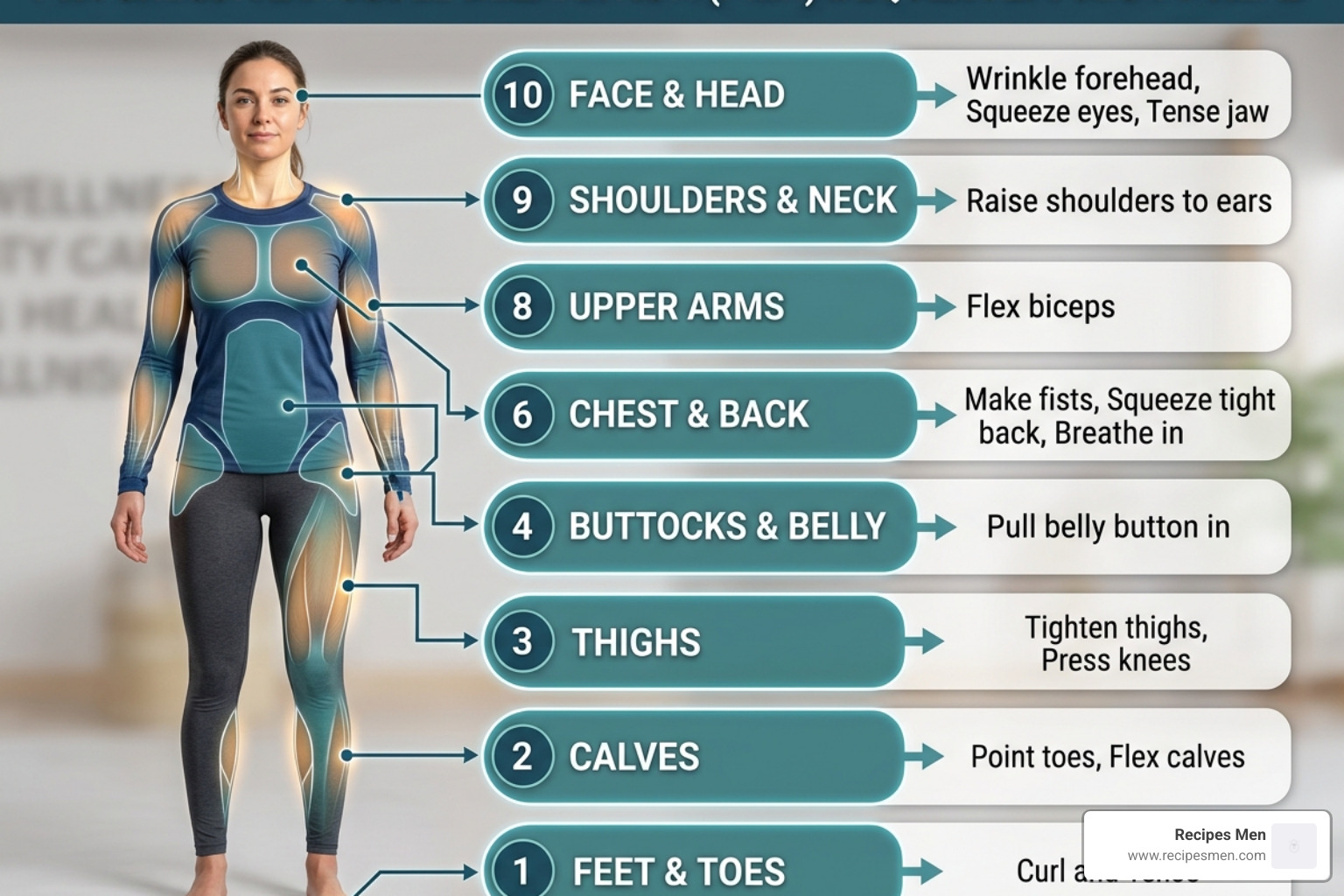
Follow this sequence, tensing each group for 5 seconds and relaxing for 10-20 seconds. Don’t forget to breathe! Inhale as you tense, and exhale fully as you release.
- Feet: Curl your toes downward and arch your feet. Feel the tension, then let it go.
- Calves: Pull your toes toward your knees to stretch and tense the calf muscles. (Be careful here to avoid cramping!)
- Thighs and Buttocks: Squeeze your thigh muscles and glutes tightly.
- Abdomen: Suck your stomach in toward your spine, as if preparing for a punch.
- Chest and Back: Take a deep breath and hold it while pulling your shoulder blades together.
- Hands and Arms: Make tight fists and flex your biceps and forearms.
- Shoulders and Neck: Shrug your shoulders up toward your ears.
- Face: Scallop your forehead, squint your eyes tightly, and clench your jaw (but not so hard you hurt your teeth).
Mastering Your Progressive Muscle Relaxation Technique Routine
Consistency is the secret sauce. We suggest setting aside 15 minutes a day—perhaps right before bed or immediately after work—to practice. As you release the tension in each muscle group, try using a verbal cue like the word “Relax” or the phrase “Let go.”
Over time, your brain will associate that word with the physical feeling of relaxation. Eventually, you may find that simply saying “relax” during a stressful meeting can trigger a mini-version of the relaxation response in your body.
Tips for Beginners and Common Mistakes to Avoid
When you first start, it’s easy to overcomplicate things. Here’s how to ensure your progressive muscle relaxation technique is effective from day one.

Avoiding Over-Tension and Injury
One of the most common mistakes is tensing too hard. You want to feel the muscle working, but you should never feel sharp or shooting pain.
- Listen to Your Body: If you have a pre-existing injury, skip that muscle group or use “Passive Relaxation” (simply focusing on the area and imagining it softening).
- Avoid Cramps: Calves and feet are prone to cramping. If you feel a cramp coming on, ease up immediately.
- Don’t Hold Your Breath: It’s tempting to stop breathing when you tense your muscles. Make sure you are inhaling with the tension and exhaling with the release.
Integrating PMR into a Busy Lifestyle
We know that finding 20 minutes in a day can feel like a tall order. The good news is that once you master the full sequence, you can use shortened versions.
- The “Quick Tense & Relax”: Instead of 14 groups, focus on four larger areas: lower limbs, stomach/chest, arms/shoulders, and face.
- Office-Friendly PMR: You can secretly tense and release your glutes or calves while sitting in a meeting to help manage rising stress levels.
- Morning vs. Evening: While many use it for sleep, practicing in the morning can help you start the day with a “clean slate” of low muscle tension.
Safety Precautions and Alternatives
While PMR is safe for the vast majority of men, there are a few exceptions. If you have a history of severe muscle spasms, serious back problems, or recent surgeries, you should check out these Safety and PMR Guidelines and consult your doctor before starting.
Progressive Muscle Relaxation vs. Passive Relaxation
If tensing your muscles causes discomfort or if you are already in significant pain, Passive Relaxation is an excellent alternative. Instead of the “tense-release” cycle, you simply move your attention through the muscle groups (like a body scan) and consciously “invite” them to soften and relax using your breath. This provides many of the same mental benefits without the physical strain of contraction.
Frequently Asked Questions about PMR
How long does it take to see results from PMR?
Most people feel a sense of relaxation immediately after their first session. However, the real benefits—like lower baseline anxiety and better sleep—usually manifest after 1-2 weeks of daily practice. Think of it like going to the gym; you’re training your relaxation “muscles.”
Can I practice progressive muscle relaxation while lying in bed?
Absolutely. In fact, practicing in bed is one of the best ways to combat insomnia. Use the Harvard Health tip: place a pillow under your knees to take the pressure off your lower back so your muscles can fully let go into the mattress.
What should I do if I feel pain during the tensing phase?
Stop immediately. PMR should be uncomfortable in a “work-out” sense, but never painful. If a specific area hurts, skip it for that session. You can still gain the benefits by focusing on the other muscle groups.
Conclusion
At Recipes Men, we believe that health is about more than just what’s on your plate—it’s about how you manage the stress of daily life. Mastering the progressive muscle relaxation technique gives you a powerful, portable tool to protect your mental and physical well-being.
Whether you’re looking to crush your next workout or finally get a decent night’s sleep, taking 15 minutes to tune into your body can make all the difference. For more advice on nutrition, fitness, and More health and wellness tips for men, keep following our latest guides. Now, take a deep breath, shrug those shoulders, and let the tension go.

