
A Guy’s Guide to Not Getting Scurvy
Why Most Men Have No Idea What They Actually Need to Eat
The daily nutritional requirements for adult male bodies aren’t as complicated as they seem — but most guys are flying blind. Here’s the quick version:
| Nutrient | Daily Target (Adult Male) |
|---|---|
| Calories | 2,400–3,000 kcal (age & activity dependent) |
| Protein | 56g (RDA) |
| Carbohydrates | 130g minimum (RDA) |
| Total Fat | 20–35% of calories |
| Dietary Fiber | 30–34g |
| Vitamin D | 600 IU |
| Calcium | 1,000mg (1,200mg if 51+) |
| Magnesium | 400–420mg |
| Potassium | 4,700mg |
| Iron | 8mg |
| Vitamin C | 90mg |
| Sodium | No more than 2,300mg |
Here’s the thing: the foods and beverages you eat every day have a profound effect on your health, energy, and how long you stay healthy. Yet most men in their 30s are too busy to think about it — and end up under-eating key nutrients while overdoing salt, saturated fat, and processed meat.
This isn’t about obsessing over every gram. It’s about understanding the basics so you can make smarter choices without turning every meal into a science experiment.
The Dietary Guidelines for Americans frames it well with what’s known as the 85-15 approach: roughly 85% of your daily calories should come from nutrient-dense whole foods, leaving just 15% for the less-perfect stuff. That’s a pretty forgiving framework.
Most adult men fall short on fiber, potassium, vitamin D, and calcium — while consistently going over on sodium and saturated fat. That gap between what you should eat and what you actually eat is exactly what this guide is here to close.
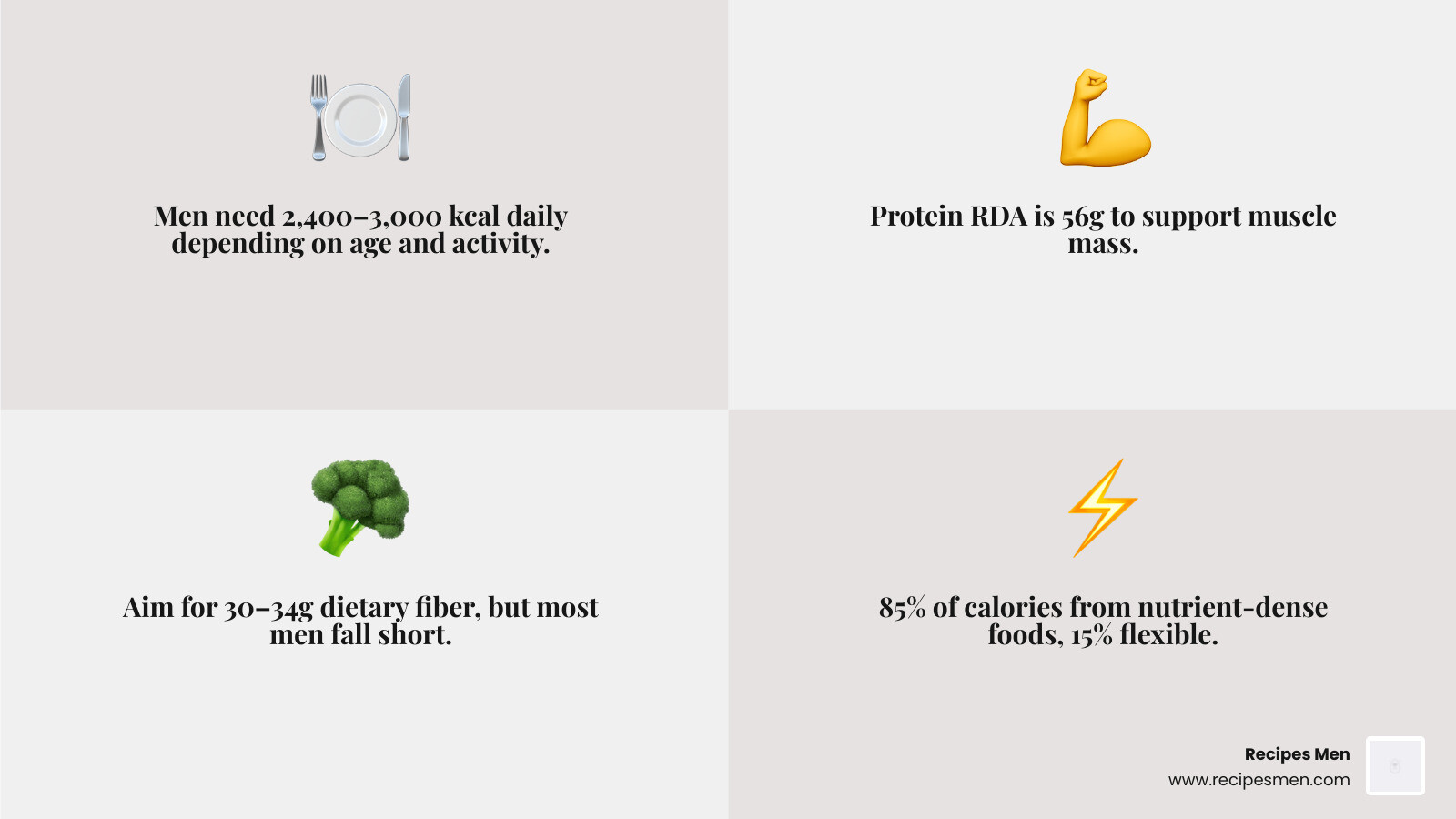
Calorie and Macronutrient Targets for Men
When we talk about energy, we’re talking about calories. For men, this is a bit of a balancing act. Because we typically have more muscle tissue than women, our engines tend to burn hotter—meaning we need more fuel to keep everything running smoothly. Muscle is metabolically active; it requires energy just to exist.
However, your “fuel” needs aren’t static. They shift based on how much you move and how old you are. If you’re a 25-year-old athlete, your needs look very different from a 55-year-old who spends most of his day at a desk. To get a professional handle on how these variables interact, the Nutritional Requirements – Nutrition – Merck Manual Professional Edition provides a deep dive into how our bodies process these inputs.
Understanding Macronutrient Ratios
Macronutrients—protein, carbohydrates, and fats—are the “Big Three.” The Acceptable Macronutrient Distribution Ranges (AMDR) give us a flexible window for how to divide our plate:
- Protein: The Recommended Dietary Allowance (RDA) for adult men is 56 grams per day. While many of us in the gym world aim higher to support muscle growth, 56g is the baseline to prevent deficiency.
- Carbohydrates: Your brain’s preferred fuel. The RDA is a minimum of 130 grams per day. Ideally, 45-65% of your total calories should come from carbs, focusing on unrefined sources like whole grains and legumes.
- Total Fat: You need fat for hormone production and vitamin absorption. Aim for 20-35% of your daily calories.
- The Limits: We should keep saturated fat to less than 10% of our total calories. For a 2,500-calorie diet, that’s about 28 grams. We also need essential fatty acids like linoleic acid to keep our cells healthy.
Calorie Needs Across the Lifespan
As we head through 2026, the focus has shifted toward “precision nutrition”—matching your intake to your actual output. Here is a breakdown of estimated daily calorie needs based on your activity level:
| Age Group | Sedentary | Moderately Active | Active |
|---|---|---|---|
| 19-30 | 2,400 | 2,600–2,800 | 3,000 |
| 31-50 | 2,200 | 2,400–2,600 | 2,800–3,000 |
| 51+ | 2,000 | 2,200–2,400 | 2,400–2,800 |
A “sedentary” lifestyle means you only do the basic movements of daily life. “Moderately active” involves walking 1.5 to 3 miles a day at a brisk pace, and “active” means you’re doing more than that. As we age, our metabolic rate naturally slows down, partly because we tend to lose muscle mass. This is why a 60-year-old man generally needs about 400–600 fewer calories than his 20-year-old self to maintain the same weight.
Essential Micronutrients and Daily Nutritional Requirements for Adult Male
If calories are the gasoline, micronutrients (vitamins and minerals) are the oil and spark plugs. You don’t need much of them, but if they’re missing, the whole machine grinds to a halt. For a full list of these targets, the Nutrient Recommendations for Adults is an excellent resource to keep bookmarked.

Key Minerals and Tolerable Upper Intake Levels (UL)
There is a ceiling to how much of certain nutrients you should consume. This is known as the Tolerable Upper Intake Level (UL).
- Sodium: This is the big one. Most American men consume about 4,400mg a day—nearly double the UL of 2,300mg. Excess sodium is a direct ticket to high blood pressure and kidney stress.
- Magnesium (400–420mg): Crucial for over 300 biochemical reactions, including muscle and nerve function.
- Potassium (4,700mg): We need this to offset the damage done by sodium. It helps lower blood pressure, yet very few men actually hit this target.
- Calcium: We need 1,000mg daily until age 50. Once we hit 51, that requirement jumps to 1,200mg to protect bone density.
- Zinc & Selenium: Important for immune function and prostate health, but don’t overdo the supplements—getting these from food like oysters, beef, and Brazil nuts is safer.
Common Nutrient Shortfalls in Men
We often think of malnutrition as “not enough food,” but in modern times, it’s usually “not enough of the right stuff.”
- Vitamin D: Often called the “sunshine vitamin,” many of us spend too much time indoors. We need 600 IU daily, but many men are chronically low, which affects testosterone and bone health.
- Vitamin B12: This becomes a major issue as we age. About 10-30% of older adults develop atrophic gastritis, which makes it hard to absorb B12 from meat. If you’re over 50, you might need to look at fortified cereals or a supplement.
- Fiber: The average guy eats about half of the 30-34g he needs. This isn’t just about “regularity”; it’s about heart health and preventing bowel cancer—the third most common cancer in men.
Building a Healthy Dietary Pattern
We don’t eat “nutrients”; we eat food. Building a pattern means looking at the big picture. The USDA “Healthy U.S.-Style” pattern is a great blueprint. For a man on a 2,600-calorie diet, that looks like:
- Vegetables: 3.5 cups per day (aim for variety: dark green, red, orange, and starchy).
- Fruits: 2 cups per day (whole fruit is better than juice because of the fiber).
- Grains: 9 ounces per day (at least half should be whole grains).
- Dairy: 3 cups of low-fat or fat-free options.
- Protein: 6.5 ounces of lean protein (fish, poultry, beans, or lean meats).
For more specific UK-based insights that emphasize heart health and reducing processed meat, check out the Recommendations for men | British Nutrition Foundation.
Managing Dietary Components of Concern
To keep the engine running for the long haul, we have to limit the “gunk.”
- Added Sugars: Limit these to less than 10% of your calories. That’s about 12 teaspoons for a standard diet. Most of this comes from sodas and energy drinks.
- Saturated Fat: Swap the butter and lard for unsaturated fats found in olive oil, avocados, and nuts.
- Processed Meats: Bacon, deli meats, and sausages are linked to higher cancer risks. Try to keep red and processed meat intake to no more than 70g (about the size of a deck of cards) per day.
- Oily Fish: We should all be eating at least one portion (140g) of oily fish like salmon or mackerel per week for those essential Omega-3s.
The Role of Fiber and Hydration
Fiber is the unsung hero of the male diet. It keeps you full, lowers cholesterol, and helps manage blood sugar. If you aren’t used to it, start slow—adding too much fiber too fast without enough water is a recipe for a bad afternoon.
Speaking of water, hydration is non-negotiable. While the “8 glasses a day” rule is a bit of a myth (needs vary by size and sweat rate), a good rule of thumb is to check your urine color—it should be pale yellow, like lemonade, not dark like apple juice.
Customizing Your Daily Nutritional Requirements for Adult Male
A “perfect” diet that you hate is a diet you won’t follow. You have to customize these guidelines to fit your life, your culture, and your wallet. Healthy eating doesn’t have to mean expensive organic kale salads. Frozen vegetables are just as nutritious as fresh ones, and dried beans are one of the cheapest, most nutrient-dense proteins on the planet.

Deciphering Food Labels and Daily Values (DV)
When you look at a can of beans, you’ll see “Daily Value” (%DV). This is a standardized reference created by the FDA to help you compare products.
- 5% DV or less is considered low.
- 20% DV or more is considered high.
Use this to your advantage. Look for foods that are “high” in fiber and potassium and “low” in sodium and saturated fat. %DV is usually based on a 2,000-calorie diet, so if you’re an active guy eating 3,000 calories, your personal percentages will be slightly lower. For more on how these values are calculated across different life stages, see 5 Nutritional Considerations for Adults.
Practical Meal Planning for Men
At RecipesMen, we’re all about making this easy. You don’t need to be a chef to hit your daily nutritional requirements for adult male health.
- The “Plate Method”: Fill half your plate with veggies, a quarter with lean protein, and a quarter with whole grains.
- Smart Snacking: Swap the chips for a handful of walnuts or an apple with peanut butter.
- Lean Swaps: Use ground turkey or 90/10 beef instead of the greasy stuff.
- Timing: Try to eat a solid breakfast with protein to prevent “hanger” and overeating at night.
Frequently Asked Questions about Daily Nutritional Requirements for Adult Male
What is the difference between RDA and AI?
The Recommended Dietary Allowance (RDA) is the average daily intake level sufficient to meet the needs of nearly all (97–98%) healthy people. Adequate Intake (AI) is used when there isn’t enough scientific evidence to set a firm RDA; it’s basically a “best estimate” based on what healthy people typically consume.
Do men over 50 need different nutrients?
Yes. As we cross the 50-year mark, our ability to absorb Vitamin B12 drops, so we need to seek out fortified foods. Our calcium needs also increase to 1,200mg to prevent bone thinning. Additionally, since our metabolism slows, we need to focus more on nutrient density—getting more vitamins for fewer calories.
Are routine nutritional supplements necessary for men?
In most cases, no. Most experts agree that you should get your nutrients from whole foods first. Supplements like Vitamin A can actually be toxic if taken in excess (hypervitaminosis A), leading to headaches and bone issues. Unless a doctor has identified a specific deficiency through blood work, stick to the grocery store, not the supplement aisle.
Conclusion
Meeting your daily nutritional requirements for adult male wellness isn’t about perfection; it’s about consistency. By focusing on the 85-15 rule, upping your fiber, and keeping an eye on your sodium, you’re already ahead of most guys.
At RecipesMen, we believe that healthy eating should be straightforward and, above all, tasty. You don’t have to sacrifice flavor to protect your heart or build muscle. Ready to start putting this into practice? Start cooking healthy recipes today and take control of your long-term wellness, one meal at a time.

