
Evening Stretch Routines: Knot Your Average Bedtime Ritual
Why Stretch Routines Evening Calm Should Be Part of Your Night
Stretch routines evening calm is one of the most underrated tools for better sleep — and it takes less than 20 minutes.
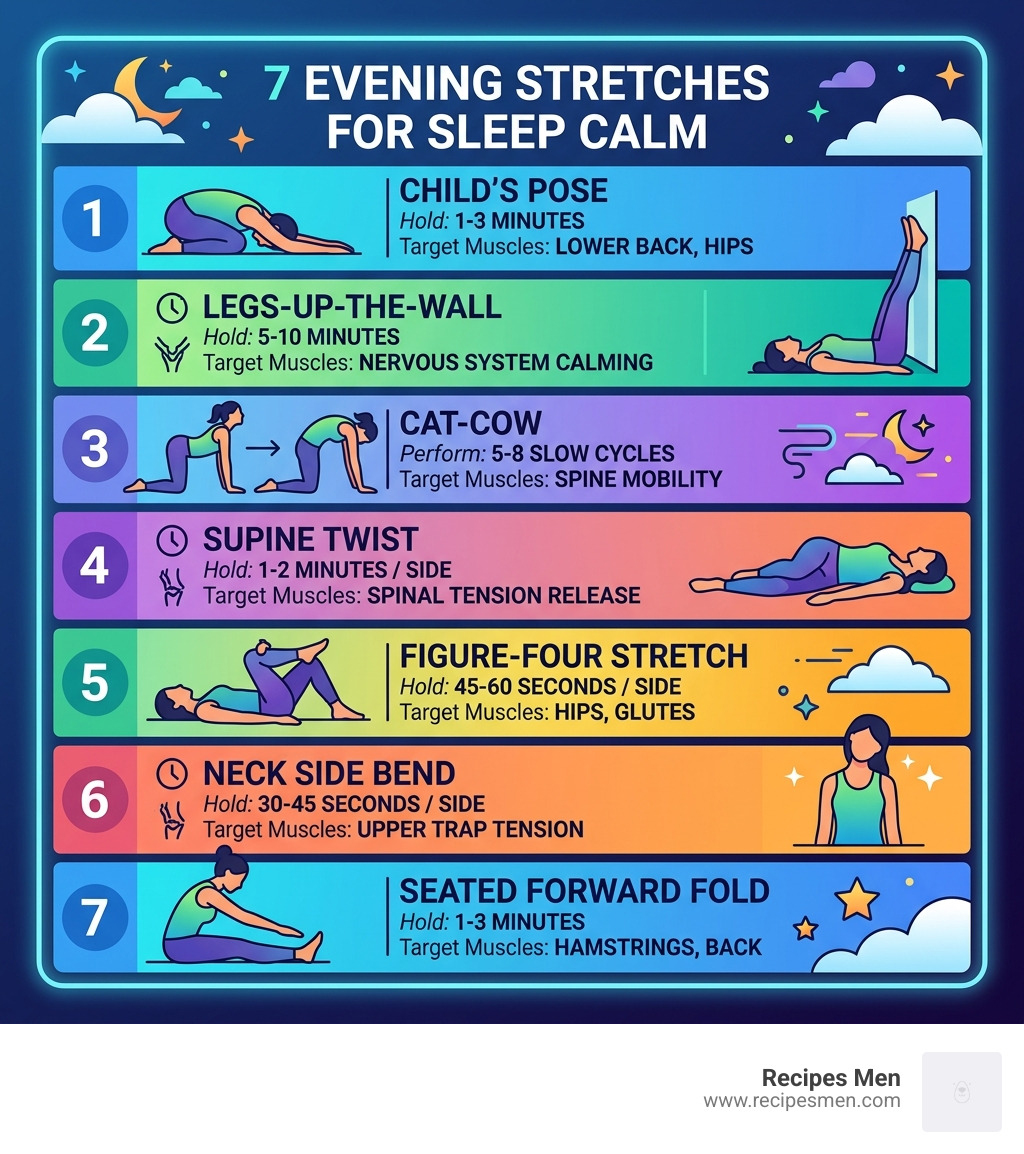
Here are the best evening stretches to wind down fast:
- Child’s Pose – releases lower back and hips, hold 1-3 minutes
- Legs-Up-the-Wall – calms the nervous system, hold 5-10 minutes
- Cat-Cow – mobilizes the spine, 5-8 slow cycles
- Supine Twist – releases spinal tension, hold 1-2 minutes per side
- Figure-Four Stretch – opens hips and glutes, hold 45-60 seconds per side
- Neck Side Bend – relieves upper trap tension, hold 30-45 seconds per side
- Seated Forward Fold – stretches hamstrings and back, hold 1-3 minutes
When to do it: 30-60 minutes before bed. Keep stretches gentle and static — no bouncing, no pain.
Most guys end the day by scrolling their phone until they pass out. But your body doesn’t just switch off because you want it to.
After hours of sitting, commuting, and stress, your muscles hold tension you don’t even notice. Your nervous system is still running in high-alert mode. And going straight from your couch to your pillow often means lying awake, stiff, and wired.
That’s where a simple evening stretch routine changes the game.
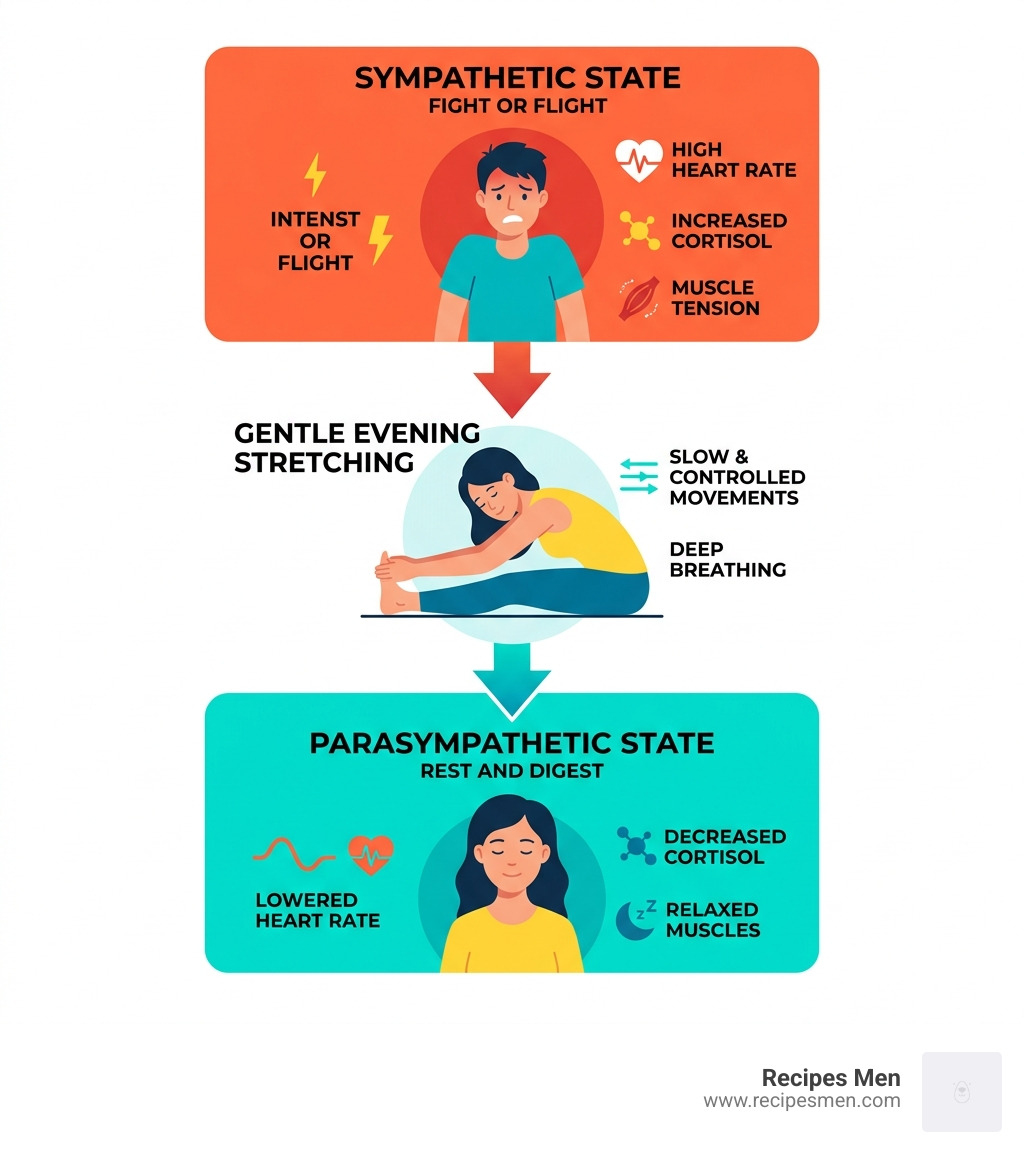
Gentle stretching before bed signals your body to shift from “go mode” into rest. It activates the parasympathetic nervous system — the part responsible for recovery and sleep. A 2021 study found that low-intensity evening exercise can reduce the time it takes to fall asleep and improve overall sleep quality.
And unlike a hard workout, it won’t keep you up.
The Science of Stretch Routines Evening Calm
We often think of stretching as something athletes do before a game, but the biological impact of a nightly routine goes far deeper than just “getting flexible.” When we engage in stretch routines evening calm, we are essentially performing a manual override on our nervous system.
The primary player here is the vagus nerve. This is the longest nerve in your body, and it acts as the “on-switch” for your parasympathetic nervous system. By performing slow, controlled movements and deep breathing, you stimulate the vagus nerve, which tells your brain to lower your heart rate and reduce cortisol levels. Cortisol is the “stress hormone” that keeps you alert; if it’s too high at 11:00 PM, you’re not going to have a good night.
Research backs this up. A 2016 review of studies found a direct link between meditative movements (like the gentle yoga-inspired stretches we recommend) and significantly improved sleep quality. This isn’t just about feeling good in the moment—it’s about improving your overall quality of life through better rest.
Furthermore, a 2021 study showed that low-intensity exercises in the evening, such as gentle stretching, reduce the time it takes to fall asleep. By stabilizing your circadian rhythm—your body’s internal clock—you prime yourself for a deeper, more restorative slumber.
Why Evening Stretching Differs from Morning Routines
It’s important to understand that an evening stretch is not a morning warm-up. In the morning, your goal is “up-regulation”—increasing blood flow, raising your body temperature, and preparing for high-intensity activity. Morning stretches are often dynamic (think leg swings or arm circles).
Evening stretching is about “down-regulation.” We want to lower your heart rate and reduce overall arousal. While morning routines focus on power and range of motion, stretch routines evening calm focus on “letting go.” We use static stretches—holding a position for 30 seconds to several minutes—to allow the fascia and muscles to yield without triggering a “startle” response in the body.
Addressing Insomnia and Muscle Cramps
For many of us, the barrier to sleep isn’t just a busy mind; it’s a restless body. If you’ve ever experienced restless legs or painful calf cramps in the middle of the night, you know how disruptive they can be.
Muscle tension from the day can lead to spasms when the body finally tries to relax. By incorporating a 10-minute evening yoga practice, you help flush out metabolic byproducts like lactic acid and improve blood flow to tight areas. This “resets” the muscle spindles, making them less likely to fire off a cramp while you’re trying to dream. For guys over 60, this is especially critical; a 2022 review of 12 trials found that consistent exercise and stretching improved sleep for seniors both with and without insomnia.
A 15-Minute Sequence for Total Relaxation
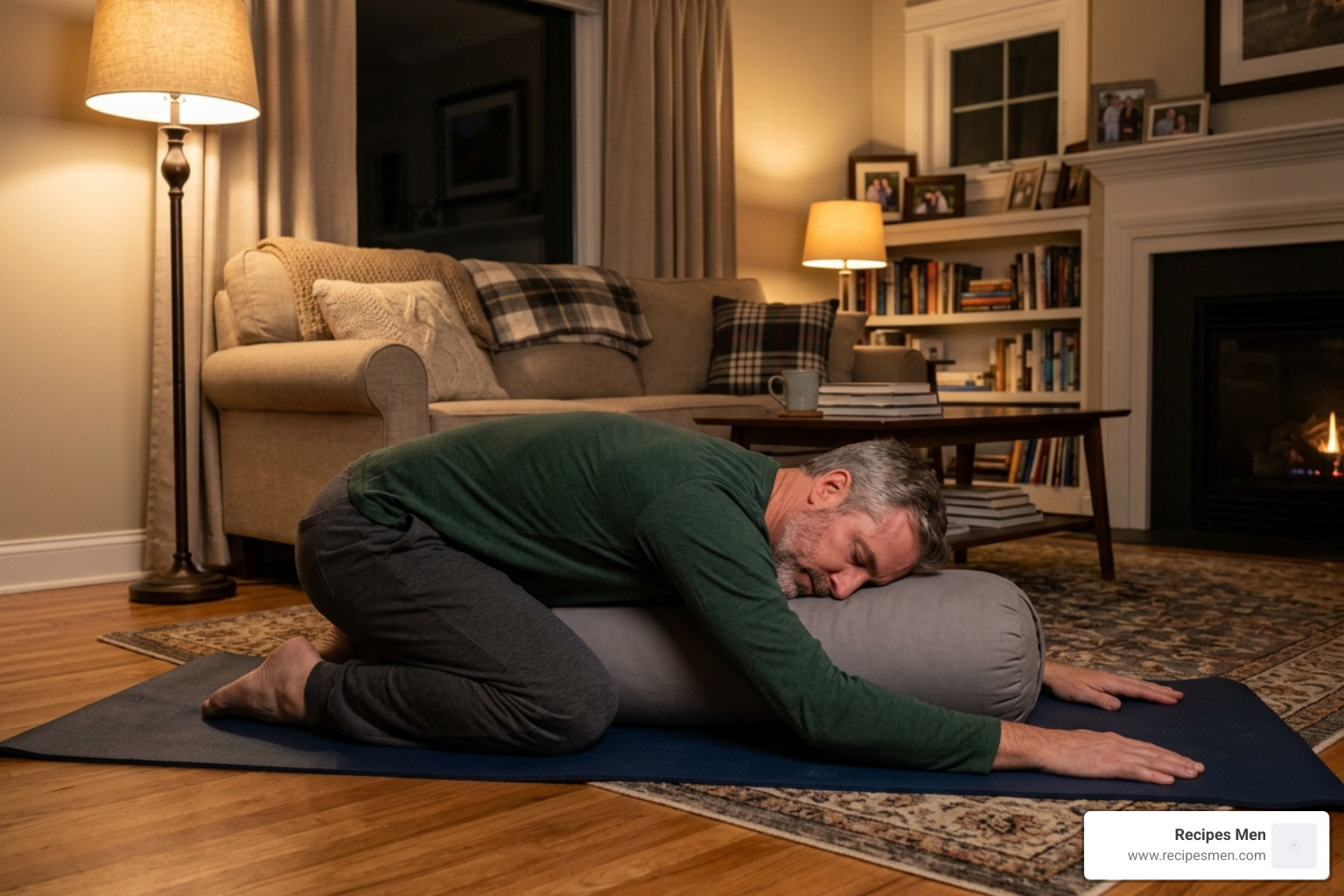
You don’t need an hour-long session to see results. We recommend a routine lasting between 10 and 20 minutes. The sweet spot is starting your routine about 30 to 60 minutes before you actually want to be under the covers. This gives your body time to “cool down” after the movement.
Many people ask if they should stretch on the floor or in bed. Both have benefits, as shown in the table below:
| Feature | Floor-Based Stretching | Bed-Based Stretching |
|---|---|---|
| Stability | High; better for spinal alignment. | Low; mattress can cause rounding. |
| Convenience | Requires a mat or rug. | Zero setup; go straight to sleep. |
| Intensity | Easier to apply gentle pressure. | Best for restorative, passive poses. |
| Focus | Better for “active” relaxation. | Ideal for those with limited mobility. |
Upper Body Release: Neck, Shoulders, and Back
Most men carry their stress in the “upper triangle”—the neck, tops of the shoulders, and the mid-back. If you spend your day at a desk or driving, these muscles are likely locked in a shortened position.
- The Bear Hug: Stand or sit tall. Inhale and open your arms wide. As you exhale, wrap your arms around yourself, grabbing your opposite shoulder blades. Breathe into the space between your shoulders for 30 seconds.
- Neck Side Bend: Drop your right ear toward your right shoulder. Don’t pull hard; just let the weight of your head do the work. Hold for 5 deep breaths per side.
- Cat-Cow: On hands and knees, inhale as you arch your back (Cow), and exhale as you round your spine like a Halloween cat (Cat). This mobilizes the vertebrae and releases the lower back.
- Thread the Needle: From all fours, slide your right arm under your left side until your shoulder touches the floor. This provides a deep twist for the thoracic spine.
- Doorway Chest Opener: Stand in a doorway, place your forearms on the frame, and gently lean forward. This opens the pecs, which are often tight from “screen posture.”
For a deeper dive into these movements, check out this comprehensive evening stretch guide.
Lower Body Stretch Routines Evening Calm
The hips and hamstrings are the “powerhouse” of the body, but they are also where we store a lot of physical tension. Tight hip flexors can actually tug on your lower back, causing that dull ache many of us feel at the end of the day.
- Kneeling Hip Flexor Stretch: Kneel on one knee, other foot forward. Tuck your pelvis slightly and shift forward. You’ll feel this in the front of the hip.
- Figure-Four: Lie on your back, cross your right ankle over your left knee, and pull your left thigh toward your chest. This is the ultimate glute and piriformis release.
- Hamstring Strap Stretch: Use a towel or a yoga strap. Lie on your back, loop the strap around your foot, and gently lift your leg. Keep the knee slightly bent to protect the joint.
- Happy Baby: Lie on your back, grab the outsides of your feet, and pull your knees toward your armpits. It looks ridiculous, but it’s one of the best ways to release the pelvic floor and lower back.
- Legs-Up-the-Wall (Viparita Karani): This is the king of evening wind-down poses. It reverses blood flow, reduces swelling in the ankles, and triggers a massive relaxation response in the brain.
Mastering the Mind-Body Connection
Stretching is only half the battle. To truly achieve an evening calm, you have to master your breath. If you are stretching but holding your breath or thinking about your morning meeting, your nervous system will stay in “high alert.”
We recommend the 4-7-8 Breathing Technique:
- Inhale through your nose for a count of 4.
- Hold your breath for a count of 7.
- Exhale forcefully through your mouth for a count of 8.
This specific cadence is a physiological “hack” that forces the heart rate to slow down. Combine this with a “body scan” while you hold your stretches. Start at your toes and mentally check in: are you clenching your jaw? Are your shoulders hiked up to your ears? Consciously “drop” those muscles as you exhale. This 9-step evening routine integrates these breathing cues perfectly.
Modifications for Beginners and Seniors
If you aren’t particularly flexible, don’t sweat it. The goal isn’t to touch your toes; it’s to relax your nervous system.
- Use Props: Don’t be afraid to use pillows, folded blankets, or yoga blocks. If you can’t reach the floor in a seated fold, put a stack of pillows on your lap and lean into them.
- Limited Mobility: If getting on the floor is difficult, most of these stretches can be done in a sturdy chair. For example, the Figure-Four can be done while seated by crossing your ankle over your knee and leaning forward slightly.
- The 60+ Advantage: As mentioned earlier, a 2022 review confirmed that consistent movement is a game-changer for older adults. It keeps joints lubricated and reduces the “stiffness” that often leads to middle-of-the-night wake-ups.
Common Mistakes and Consistency Tips

Even with the best intentions, there are a few traps guys fall into:
- Overstretching: This isn’t a gym workout. If you push until it hurts, your muscles will contract defensively. Aim for a 3 or 4 out of 10 on the intensity scale.
- Holding Your Breath: As soon as you stop breathing, you signal “danger” to your brain. Keep the air moving.
- Inconsistency: Stretching once every two weeks won’t fix chronic sleep issues. Habit stack your routine: do it right after you brush your teeth or while your evening tea is steeping.
Speaking of evening habits, what you put in your body matters too. If you find yourself hungry before bed, skip the sugary cereal. Instead, check out our guide on how to stop the fridge raid with these healthy evening protein snacks to keep your blood sugar stable through the night.
Frequently Asked Questions about Bedtime Stretching
How long should an evening stretch routine last?
For most men, 10 to 20 minutes is the “Goldilocks” zone. It’s long enough to cover the major muscle groups (neck, back, hips) but short enough that it doesn’t feel like a chore you’ll want to skip.
Can I do these stretch routines evening calm in bed?
Absolutely. While a floor provides better support for spinal alignment, doing your routine in bed is better than not doing it at all. Poses like the Figure-Four, Supine Twist, and Happy Baby are perfectly suited for a mattress.
Is it safe to stretch every night?
Yes. Unlike heavy weightlifting, which requires recovery days, gentle static stretching is safe and beneficial to perform daily. In fact, consistency is what leads to long-term improvements in sleep quality.
Conclusion
At RecipesMen, we believe that health isn’t just about what you lift or what you eat—it’s about how you recover. Incorporating stretch routines evening calm into your nightly ritual is a low-effort, high-reward investment in your mental clarity and physical longevity.
By taking just 15 minutes to unknot the day’s stress, you aren’t just preparing for sleep; you’re setting the stage for a more productive, pain-free tomorrow. Start small, breathe deep, and let your body finally find its “off” switch.
Ready to take control of your health from the kitchen to the bedroom? Start your wellness journey today with our straightforward guides and recipes.

