
How to eat low carb and high protein without losing your mind
Why Low Carb High Protein Eating Actually Works (And Where to Start)
Low carb high protein eating is one of the most effective ways to lose weight, control hunger, and keep your energy steady throughout the day.
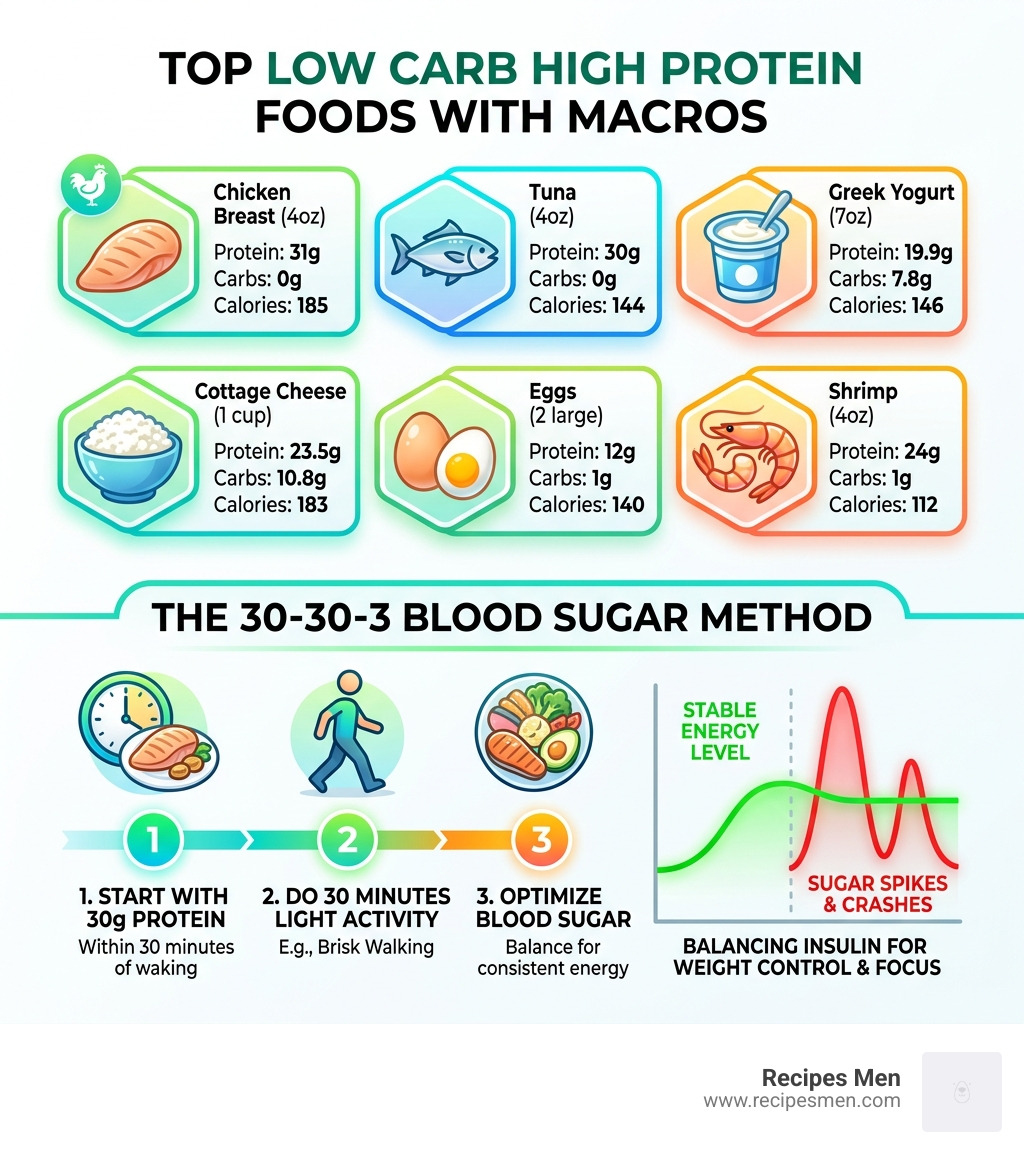
Here are the best low carb, high protein foods to start with:
| Food | Protein | Carbs | Calories |
|---|---|---|---|
| Chicken breast (4oz) | 31g | 0g | 185 |
| Tuna (4oz) | 30g | 0g | 144 |
| Canned salmon (3oz) | 19.6g | 0g | 117 |
| Greek yogurt (7oz) | 19.9g | 7.8g | 146 |
| Cottage cheese (1 cup) | 23.5g | 10.8g | 183 |
| Eggs (2 large) | 12g | 1g | 140 |
| Shrimp (4oz) | 24g | 1g | 112 |
| Tofu (1 cup) | 20g | 4g | 181 |
| Edamame (1 cup) | 17g | 8g | 189 |
Look, most guys in their 30s aren’t failing because they lack willpower. They’re failing because the plan is too complicated.
Tracking every macro. Cutting out entire food groups. Cooking three different meals because the family won’t eat what you’re eating. It’s exhausting.
The good news? A low carb high protein approach doesn’t have to be that hard.
The basic idea is simple: eat more protein, eat fewer carbs. That shift alone does a lot of heavy lifting – it keeps you fuller longer, helps your body burn fat more efficiently, and makes it easier to stay in a calorie deficit without feeling like you’re starving.
Low-carb diets generally mean keeping carbs below 26% of your daily calories – that’s under 130g on a 2,000-calorie day. Pair that with a solid protein intake (around 1.2 to 2 grams per kilogram of body weight for active guys), and you’ve got a framework that actually works.
No wizardry. No expensive supplements. Just real food, arranged smarter.
Defining the Low Carb High Protein Approach
When we talk about a low carb high protein diet, we are looking at a spectrum. There isn’t one “official” definition, but according to Low-Carb, High-Protein Diets – Harvard Health, these plans typically involve getting 30% to 50% of your total daily calories from protein.
To put that into perspective, the American Heart Association (AHA) usually suggests a more modest 10% to 35% from protein. When we push that protein lever higher, we naturally have to pull the carbohydrate lever lower. A standard low-carb diet restricts carbohydrates to less than 26% of total daily calories. On a 2,000-calorie diet, that means staying under 130 grams of carbs per day.
The Science of Why It Works
There are three main reasons this combo is a powerhouse for men’s health:
- Satiety: Protein is the most satiating macronutrient. It triggers hormones that tell your brain you’re full, which prevents the “hangry” mid-afternoon raids on the vending machine.
- Thermic Effect of Food (TEF): Your body actually burns more calories digesting protein than it does digesting fats or carbs. You’re essentially boosting your metabolism just by eating.
- Muscle Maintenance: When you lose weight, your body often wants to burn muscle for fuel. High protein intake, especially when paired with resistance training, signals your body to keep the muscle and burn the fat instead.
Popular Variations
You’ve likely heard of several versions of this diet. While they all share the low carb high protein DNA, they differ in their strictness:
- The Atkins Diet: The classic low-carb plan that focuses on high protein and high fat.
- The Ketogenic (Keto) Diet: This is a very low-carb version (under 10% carbs) where the goal is ketosis—a state where your body burns fat for fuel instead of glucose. Interestingly, keto is often moderate in protein, as too much protein can sometimes kick you out of ketosis.
- The Zone Diet: A more balanced approach aiming for a 40-30-30 ratio (40% carbs, 30% protein, 30% fat).
- Paleo: Focuses on whole foods our ancestors might have eaten, naturally resulting in higher protein and lower carb counts by eliminating grains and processed sugars.
Top Foods for a Low Carb High Protein Lifestyle
Success in 2026 isn’t about eating plain, dry chicken breasts until you lose your mind. It’s about variety. We want to stock our kitchens with nutrient-dense foods that hit those high protein targets without sneaking in hidden sugars.

Best Animal-Based Low Carb High Protein Sources
Animal products are “complete” proteins, meaning they contain all the essential amino acids your body can’t make on its own.
- Bison and Lean Beef: Bison is a fantastic, lean alternative to beef, offering about 28g of protein and 5g of fat per 4oz serving with zero carbs.
- Poultry: Chicken breast is the gold standard (31g protein per 4oz), but don’t sleep on ground turkey (22g protein per 4oz) for easy meal prep like taco bowls or burgers.
- Seafood: This is where you get those heart-healthy Omega-3s. Tuna delivers a massive 30g of protein per 4oz, while wild-caught cod and shrimp are lean, high-protein options that cook in minutes.
- Eggs: The perfect food. At 6g of protein per egg and less than 1g of carbs, they are the ultimate breakfast or snack.
- Dairy: Greek yogurt (plain, low-fat) and cottage cheese are secret weapons. A single cup of cottage cheese can pack 23.5g of protein.
As noted in High Protein, Low Carb Diet: A Complete Guide, the quality of your protein matters. We always recommend choosing whole, minimally processed sources whenever possible.
Plant-Based Low Carb High Protein Options
Whether you’re fully plant-based or just trying to do “Meatless Mondays,” you can still hit your goals.
- Tempeh and Tofu: Tempeh is a fermented soy powerhouse with 31g of protein and 16g of carbs per cup. Tofu is slightly lower in protein (20g) but also lower in carbs (4g).
- Edamame: These young soybeans are great for snacking, providing 17g of protein and 8g of carbs per cup.
- Seeds: Pumpkin seeds and hemp seeds are excellent toppers for salads or yogurt. Hemp seeds, in particular, are a complete plant protein.
- Seitan: Often called “wheat meat,” seitan is incredibly high in protein and very low in carbs, making it a favorite for plant-based athletes.
- Leafy Greens: While not “high protein” in the same way a steak is, greens like Swiss chard and collard greens provide essential vitamins and fiber with almost zero net carbs.
Macro Comparison: Animal vs. Plant Protein (Per 100g)
| Source | Protein | Net Carbs | Fat |
|---|---|---|---|
| Chicken Breast | 31g | 0g | 3.6g |
| Bison | 25g | 0g | 2.4g |
| Salmon | 20g | 0g | 13g |
| Tofu (Firm) | 8g | 2g | 4g |
| Seitan | 25g | 4g | 2g |
| Tempeh | 19g | 9g | 11g |
Health Benefits and Potential Risks to Consider
Switching to a low carb high protein diet isn’t just about looking better in a t-shirt; it has profound effects on your internal health. However, it’s not a “one size fits all” solution.
The Benefits
- Blood Sugar Regulation: By reducing refined carbs, you stop the massive insulin spikes that lead to fat storage. Research shows that a 10% loss in body weight through carb reduction can reduce insulin resistance by up to 65%.
- Heart Health: While some worry about fat intake, many find that cutting processed sugars improves their “good” HDL cholesterol and lowers triglycerides.
- Brain Health: Higher protein intake has been linked to a reduction in cognitive decline as we age. Plus, avoiding the “carb crash” means better focus during your workday.
The Risks and Downsides
We have to be honest—this diet isn’t without its controversies. According to Low-Carb, High-Protein Diets: Risks (Ketosis) and Benefits, there are a few things to watch out for:
- Kidney Function: While high protein is generally safe for healthy kidneys, it can be taxing for those with pre-existing kidney disease. Always consult your doctor if you have concerns.
- Nutrient Gaps: If you cut out all fruits and grains, you might miss out on fiber, potassium, and folate. This is why we advocate for “Smart Carbs” like berries and fibrous vegetables.
- Heart Failure Risk: One 2018 study of over 2,400 men found that those with the highest total protein intake had a 33% increased risk of heart failure. This risk was specifically associated with animal protein. The takeaway? Don’t ignore plant proteins and healthy fats.
- Bone Density: There is some conflicting evidence regarding high protein and calcium loss, though many modern studies suggest protein actually supports bone health in the long run.
Practical Strategies for Long-Term Success in 2026
The reason most diets fail is that they don’t account for real life. You have meetings, kids’ soccer games, and weekends where you just want a beer. Here is how we make low carb high protein sustainable.

The 30-30-3 Method
This is a simple rule for sustained energy:
- 30g of protein within 30 minutes of waking up.
- 30 minutes of light movement (like a walk).
- 3 grams of fiber with every meal. This keeps your blood sugar stable from the jump and prevents that 3 PM slump.
7-Day Meal Plan Framework
You don’t need a rigid script, but having a framework helps. Following a 7-Day High-Protein Low-Carb Diet Created by a Dietitian can provide the structure you need.
- Breakfast: Omelet with spinach and feta OR Greek yogurt with a handful of raspberries.
- Lunch: Grilled chicken over a massive bed of greens with avocado oil dressing OR a tuna salad lettuce wrap.
- Dinner: Baked salmon with roasted broccoli OR a bison burger (no bun) with a side of sautéed kale.
- Snacks: Hard-boiled eggs, pumpkin seeds, or a turkey stick.
Hydration and Electrolytes
When you drop carbs, your body flushes out a lot of water. This is why people see a big drop on the scale in week one—it’s mostly water. Along with that water, you lose electrolytes like sodium, magnesium, and potassium. If you feel a headache or fatigue (the “keto flu”), you likely need more salt and water.
Social Dining and “Breadless Hacks”
You don’t have to be the guy who brings a Tupperware container to a restaurant.
- The Burger Spot: Order the burger “protein style” (wrapped in lettuce) or just lose the bun.
- The Mexican Spot: Skip the rice and beans; go for a fajita bowl with double meat and extra guac.
- The Italian Spot: Look for grilled meats or fish (like Branzino) and ask for double veggies instead of pasta.
Frequently Asked Questions about High-Protein Eating
How much protein do I need daily?
The RDA is a baseline of 0.8g per kilogram of body weight, but that is the minimum to prevent deficiency. For active men looking to build or maintain muscle, the sweet spot is usually 1.2 to 2 grams per kilogram (0.54 to 0.9 grams per pound). If you weigh 200 lbs, you should aim for roughly 110g to 180g of protein daily.
Can I lose weight without counting every calorie?
Yes. Because protein is so filling, many people find they naturally eat fewer calories without trying. However, calories still count. If you’re eating 4,000 calories of ribeye and cheese, you probably won’t lose weight. Focus on satiety and whole foods first.
Who should avoid this diet?
- People with Kidney Disease: High protein can increase the workload on the kidneys.
- Pregnant or Breastfeeding Women: Carbohydrates are essential for fetal development and milk production.
- Those with a history of disordered eating: Highly restrictive diets can sometimes trigger unhealthy patterns.
- People prone to gout: High purine intake (from certain meats) can trigger flare-ups.
Conclusion
At RecipesMen, we believe that healthy eating shouldn’t feel like a second job. Transitioning to a low carb high protein lifestyle is about making smarter trades—trading the white bread for extra greens, and the sugary snacks for high-quality protein.
By focusing on straightforward, flavorful recipes and keeping your protein intake high, you’re not just losing weight; you’re building a foundation for better mental health, more energy, and a stronger body. Whether you’re firing up the grill for some bison burgers or prepping a week of Greek yogurt bowls, consistency beats perfection every single time.
Ready to take the next step? Check out our latest recipes and meal prep guides to start your journey today. Your future self will thank you.

