
Master Your Own Weight with This Bodyweight Calisthenics Routine
Why a Bodyweight Calisthenics Routine Belongs in Your Fitness Plan
A bodyweight calisthenics routine is a structured workout program that uses your own body as the only resistance — no gym, no weights, no machines required. Here’s a quick snapshot of what you need to know:
What is a bodyweight calisthenics routine?
| Element | Details |
|---|---|
| Definition | Exercises using only your bodyweight for resistance |
| Core movements | Push-ups, pull-ups, squats, lunges, planks, dips |
| Best for | Strength, muscle, endurance, and flexibility |
| Frequency | 3-4 sessions per week |
| Equipment needed | None required (pull-up bar optional) |
| Where | Home, park, hotel room — anywhere |
If you’re a busy guy in your 30s who wants to get stronger without rearranging your schedule around a gym, calisthenics might be the most practical fitness choice you can make right now.
It’s not a new idea. Your grandparents did push-ups and squats in gym class. But in 2026, bodyweight training is having a serious moment — and for good reason. It’s free, it’s flexible, and the science increasingly backs it up.
Research shows that calisthenics can build muscle and strength comparable to traditional weightlifting, as long as you push sets close to failure. One randomized trial published in the Journal of Strength and Conditioning Research found that progressive push-up training produced similar upper-body strength and muscle thickness gains to bench press training over 4-8 weeks.
And the benefits go beyond just muscle. Training outdoors — which calisthenics naturally encourages — has been shown to lower perceived effort, reduce stress, and boost mood and self-esteem.
In short: your body is already a fully equipped gym. You just need to know how to use it.
The Science and Benefits of a Bodyweight Calisthenics Routine
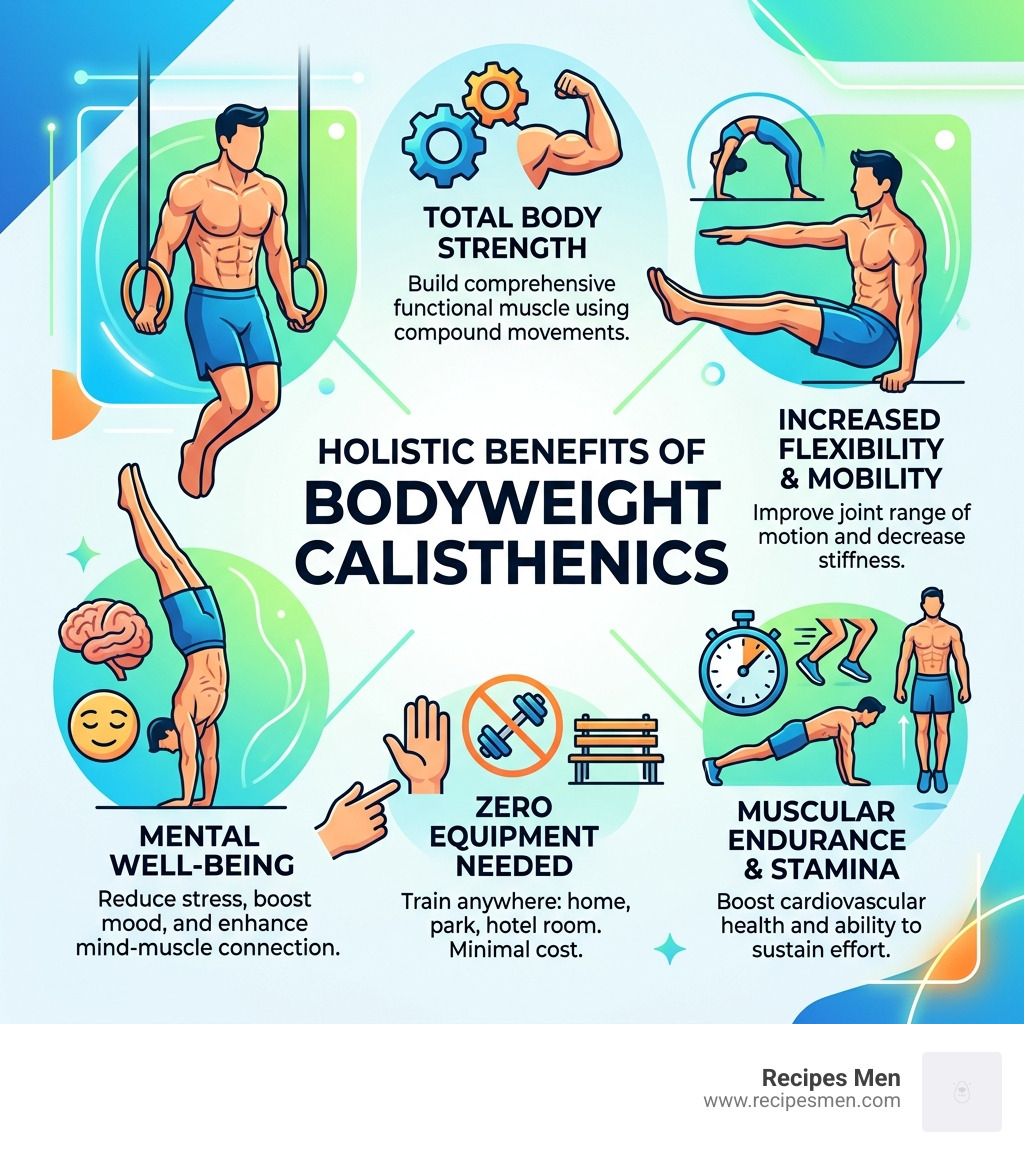
When we talk about building a “functional” physique, we’re talking about a body that doesn’t just look good but moves well in the real world. At the heart of any effective bodyweight calisthenics routine are compound movements. These are exercises that recruit multiple joints and muscle groups simultaneously. Think of a pull-up: you aren’t just hitting your biceps; you’re engaging your lats, traps, shoulders, and even your core to stabilize your frame.
Hypertrophy: Can You Really Build Muscle?
A common myth is that you need heavy iron to grow. However, muscle hypertrophy (growth) is primarily driven by mechanical tension and metabolic stress. As long as you are challenging your muscles near the point of “momentary failure,” your body will adapt by getting bigger and stronger. This is backed by a JSCR randomized trial which demonstrated that push-ups can be just as effective as the bench press for increasing muscle thickness when the difficulty is matched.
Mental Health and the Great Outdoors
In April 2026, we are seeing a massive shift toward “green exercise.” Calisthenics is the perfect partner for this. Research indicates that exercising outdoors can significantly lower cortisol levels (the stress hormone) compared to indoor training. By taking your bodyweight calisthenics routine to a local park, you aren’t just working your chest and back; you’re improving your mood and self-esteem.
Frequency and Joint Health
How often should we be doing this? WebMD and other fitness experts generally recommend 2 to 4 sessions per week. This frequency allows for the 48-hour recovery window muscles need to repair. Unlike heavy weightlifting, which can sometimes place jarring stress on the joints, calisthenics movements often feel more natural. They improve joint mobility and core stability because your midsection is forced to work as a stabilizer in almost every move — from the humble plank to the advanced handstand.
Essential Exercises and Equipment for Bodyweight Training
One of the best things about starting a bodyweight calisthenics routine is the low barrier to entry. We don’t need a $2,000 treadmill or a garage full of plates. We just need a bit of floor space and a willingness to work.

The “Big Six” Exercises
To hit every major muscle group, your routine should revolve around these staples:
- Push-ups: The gold standard for chest, shoulders, and triceps.
- Pull-ups: The king of back and bicep builders.
- Air Squats: Essential for leg power and glute development.
- Planks: For a rock-solid core and spinal stability.
- Dips: Excellent for triceps and lower chest definition.
- Lunges: Great for balance, coordination, and unilateral leg strength.
Minimalist Equipment
While you can do a lot with just the floor, adding a few simple tools can unlock your full potential:
- Pull-up Bar: Essential for vertical pulling movements.
- Resistance Bands: Perfect for assisting with difficult moves (like your first pull-up) or adding resistance to squats.
- Gymnastic Rings or Parallel Bars: These allow for deeper dips and more advanced “flow” movements.
- Floor Space: A simple yoga mat can make floor work much more comfortable for your joints.
Structuring Your Weekly Bodyweight Calisthenics Routine
How we organize our training depends on our goals and current fitness level. Most trainees find success with either a Full-Body Routine (hitting everything in one session) or a Split Routine (focusing on upper body one day and lower body the next).
For most of us, a 3-day-a-week full-body split is the sweet spot. It provides enough stimulus to grow while leaving plenty of room for active recovery — think walking, light stretching, or yoga on your “off” days.
Workout Structure Comparison
| Feature | Beginner | Intermediate | Advanced |
|---|---|---|---|
| Frequency | 3 days / week | 3-4 days / week | 4-5 days / week |
| Focus | Form & Foundation | Strength & Volume | Skills & Explosiveness |
| Rest Sets | 90-120 seconds | 60-90 seconds | 30-60 seconds |
| Rep Ranges | 5-10 (High quality) | 8-15 (Near failure) | Varied (Skill-based) |
Designing Your First Beginner Bodyweight Calisthenics Routine
If you’re just starting, don’t worry about doing 50 straight push-ups. Focus on “regressions” — easier versions of the moves that allow you to master the form.
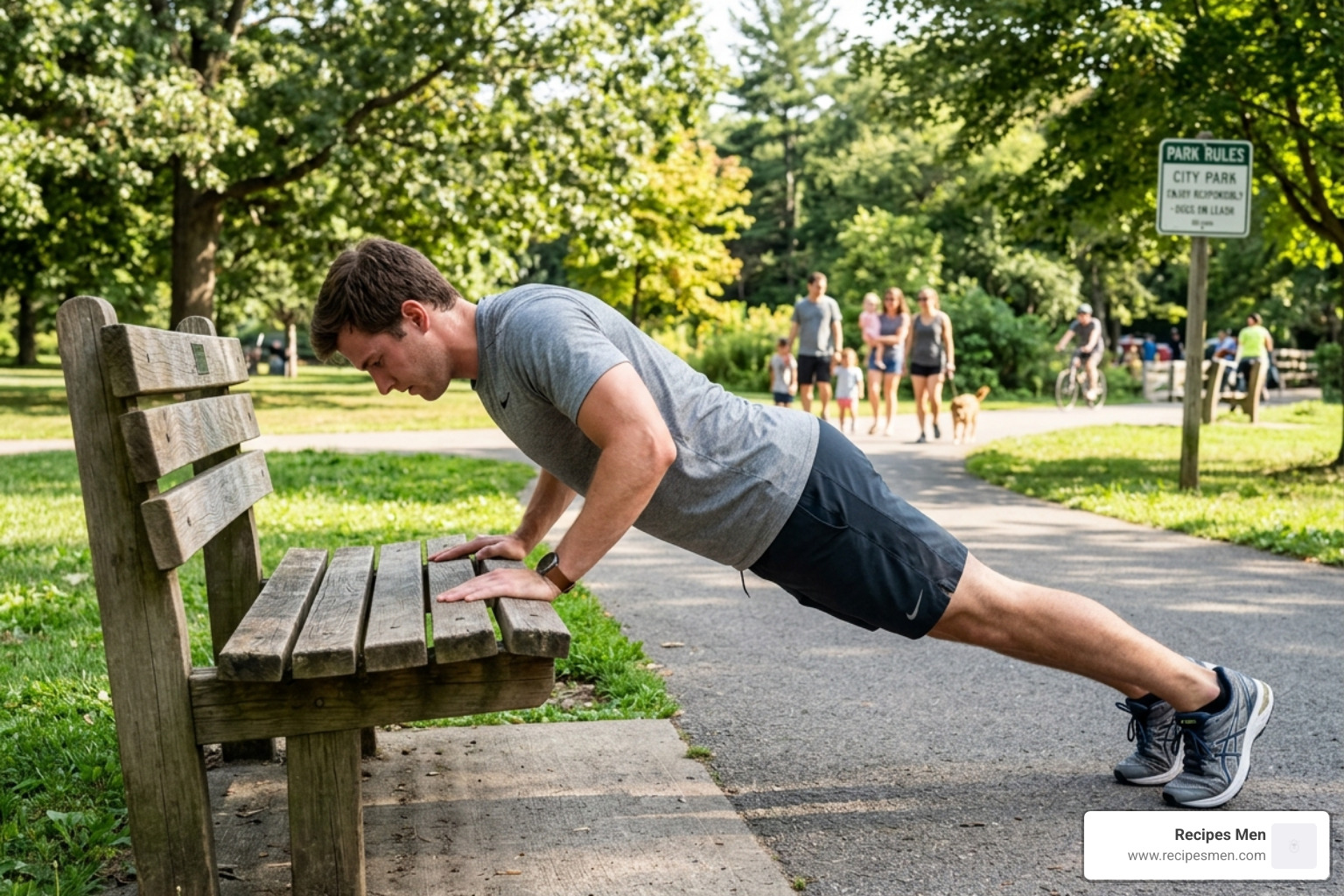
- Incline Push-ups: Use a table or a bench to elevate your hands. This reduces the weight your chest has to move.
- Box Squats: Sit down onto a chair and stand back up to ensure you’re hitting the right depth safely.
- Knee Planks: Shorten the lever by resting on your knees until your core gets stronger.
- Australian Rows: Find a low bar (or use a sturdy table) to pull your chest toward while your feet stay on the ground.
Consistency over 30 days is more important than intensity in week one. Aim for three 30-minute sessions a week, focusing on slow, controlled movements.
Advanced Progressions for Your Bodyweight Calisthenics Routine
Once the basics become easy, we don’t add weights; we change the leverage. This is the beauty of calisthenics.
- Muscle-ups: Combining a pull-up and a dip into one explosive move.
- Pistol Squats: A full squat performed on one leg.
- Planche and Front Lever: Static holds that require immense total-body tension.
- Handstand Push-ups: The ultimate shoulder strength builder.
- Tempo Variations: Try taking 4 seconds to lower yourself in a push-up. The “time under tension” will make even a standard move feel impossible.
Mastering Progression, Nutrition, and Recovery
To keep seeing results, we must apply Progressive Overload. In weightlifting, you just add 5 lbs to the bar. In a bodyweight calisthenics routine, you progress by adding reps, decreasing rest time, or moving to a harder exercise variation.
The RPE Scale and Reps-In-Reserve
We suggest using the Rate of Perceived Exertion (RPE) scale from 1 to 10.
- RPE 7-8: You feel like you could have done 2 or 3 more reps (this is called “Reps-in-Reserve” or RIR).
- RPE 10: You couldn’t possibly do another rep with good form.
For the best gains, most of your sets should be at an RPE 8, with your final set of each exercise taken to momentary failure.
Fueling the Machine
You can’t build a house without bricks. For muscle repair and protein synthesis, aim for 1.6 to 2.2 grams of protein per kilogram of bodyweight daily. If you’re looking to gain size, a slight caloric surplus (200-300 calories above maintenance) is ideal.
Don’t forget hydration! Drinking 2-3 liters of water a day keeps your joints lubricated and your energy levels high. Finally, sleep is when the magic happens. Aim for 7-9 hours of quality shut-eye to manage DOMS (Delayed Onset Muscle Soreness) and ensure you’re ready for the next session.
Frequently Asked Questions about Calisthenics
Can calisthenics build as much muscle as weightlifting?
Yes, absolutely. Muscle growth (hypertrophy) doesn’t care if the resistance comes from a dumbbell or your own torso. As long as you provide enough mechanical tension and take your sets close to failure, your body will trigger muscle thickness gains. The key is to constantly move toward harder variations so the “load” stays high.
How many days a week should I train for optimal results?
For most people, 3 to 4 days a week is the sweet spot. This allows for a 48-hour recovery window between sessions. Advanced athletes might train 5 or 6 days, but they often split their focus between “strength days” and “skill days” (like practicing handstands) to avoid overtraining.
What are the best alternatives if I cannot do a pull-up yet?
Pull-ups are tough! If you aren’t there yet, start with:
- Scapular Pulls: Just hanging from the bar and pulling your shoulder blades down and back.
- Negative Pull-ups: Use a chair to get your chin over the bar, then lower yourself as slowly as possible.
- Inverted Rows: These hit the same muscles but with your feet on the ground to reduce the load.
- Isometric Holds: Holding the “top” position of a pull-up for as long as you can to build lat engagement.
Conclusion
Mastering your own weight is one of the most rewarding fitness journeys you can take. It builds a level of functional strength and body control that carries over into every aspect of your life — from carrying all the groceries in one trip to staying injury-free as you age.
At Recipes Men, we believe that fitness should be accessible, straightforward, and effective. Whether you are following a 6-Week Full Body Calisthenics Workout Routine for Beginners or trying out The Best Full-Body Calisthenics Workout Plan To Build Muscle , the most important step is the one you take today.
Consistency is your greatest ally. Start where you are, use what you have, and do what you can. For more straightforward advice on training, recovery, and healthy eating, check out our More fitness and nutrition tips. Your body is the only gym you’ll ever truly need — it’s time to start using it.

