
Master the Basics with These Essential Home Dumbbell Moves
Why Doing Basic Dumbbell Exercises at Home Is a Game-Changer
Basic dumbbell exercises at home are one of the fastest ways for busy guys to build real strength — no gym membership, no commute, no wasted time.
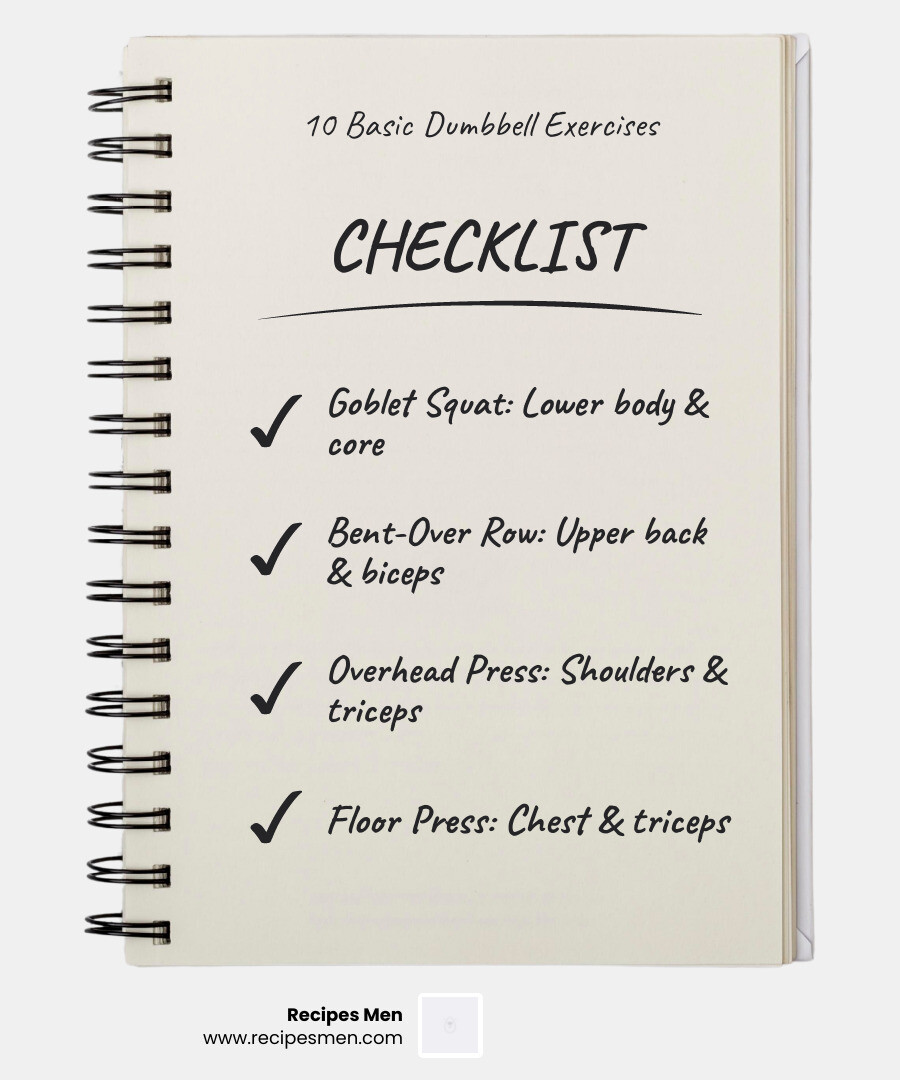
Here are the essential moves to get you started:
- Goblet Squat – lower body strength, core stability
- Romanian Deadlift – hamstrings, glutes, lower back
- Dumbbell Bent-Over Row – upper back, biceps
- Overhead Shoulder Press – shoulders, triceps
- Forward Lunge – quads, glutes, balance
- Bicep Curl – arms, forearm strength
- Dumbbell Floor Press – chest, triceps, shoulders
- Lateral Raise – shoulder definition, stability
- Tricep Kickback – triceps isolation
- Dumbbell Plank Row – core, back, anti-rotation strength
You don’t need fancy machines or a full hour to spare. A single pair of dumbbells and 15-30 minutes is genuinely enough to make progress — especially when you’re just getting started.
The truth is, most beginners overcomplicate this. They either do nothing because the gym feels intimidating, or they jump into complex programs before mastering the basics.
This guide cuts through all of that. You’ll learn exactly which moves to start with, how to do them right, and how to build a simple routine that actually fits into a busy life.
Why Start Basic Dumbbell Exercises at Home?
As we move through April 2026, the trend of home fitness has shifted from a temporary fix to a permanent lifestyle choice for many of us. Why? Because Dumbbell Exercises: Routine for Everyday Strength and Mobility offer benefits that fancy gym machines simply can’t touch.
First off, dumbbells are the kings of functional strength. Unlike machines that lock you into a fixed path, dumbbells require you to engage your stabilizer muscles to keep the weight steady. This translates directly to real-life movements, like carrying a heavy box of groceries or picking up your kids.
Furthermore, dumbbells allow for unilateral training, meaning you can work one side of your body at a time. This is a secret weapon for fixing muscle imbalances—we’ve all got one arm or leg that’s slightly stronger than the other. By focusing on each side individually, we build a more symmetrical, injury-resistant physique.
From a health perspective, the data is clear: strength training boosts your metabolic rate, helping you burn more calories even when you’re just sitting on the couch. It also promotes bone density and improves joint mobility. Best of all, a pair of dumbbells takes up about as much space as a pair of shoes, making them the ultimate space-saving equipment for any apartment or house.
Getting Started: Equipment and Weight Selection
One of the biggest hurdles for beginners is staring at a rack of weights and wondering, “Which ones do I actually need?”
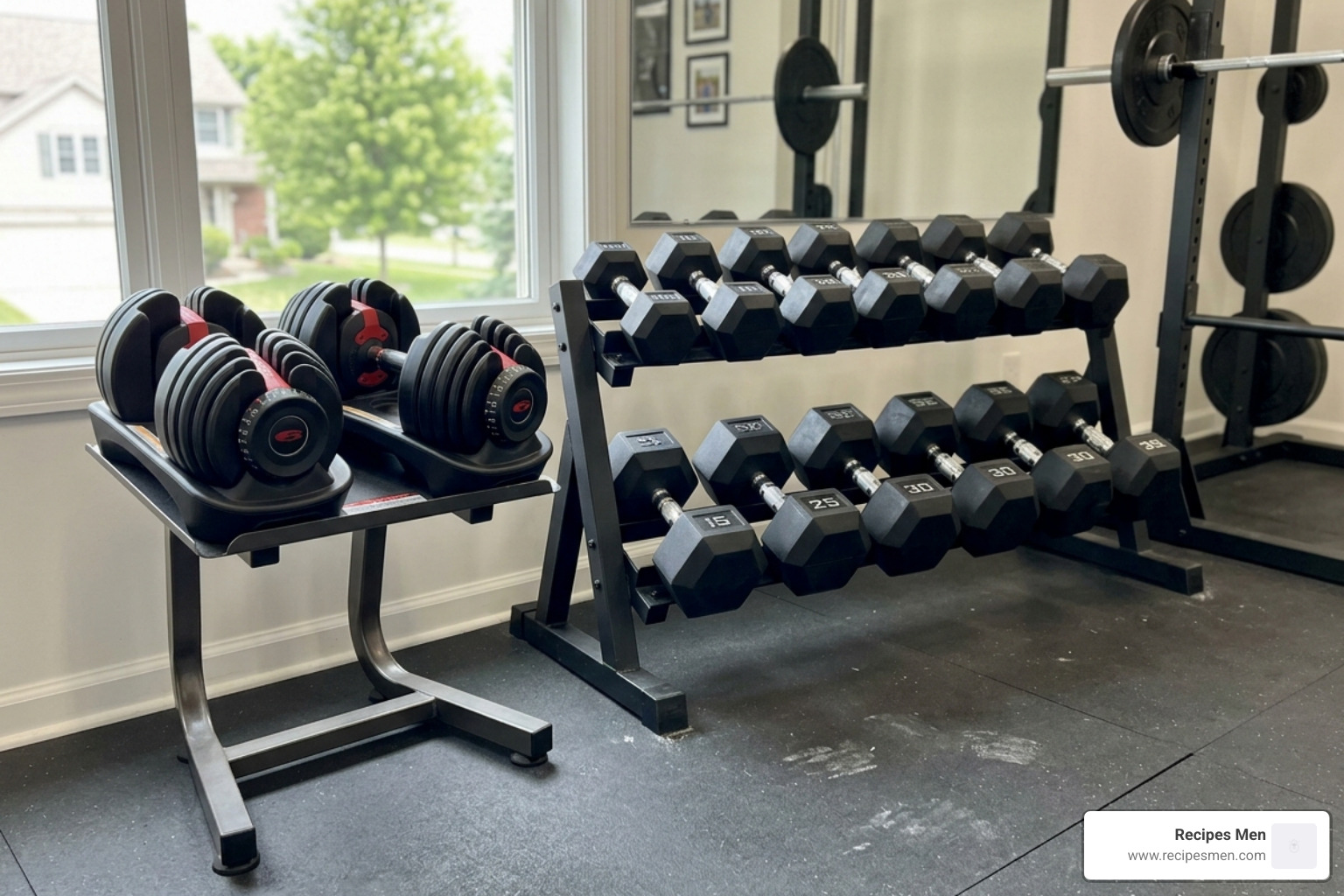
For a solid home setup, we generally recommend two paths:
- Fixed Sets: A light pair and a medium pair.
- Adjustable Dumbbells: These are a bit more of an investment upfront but save incredible amounts of space and allow you to progress for years.
How much weight should you lift? Based on current fitness standards for 2026, beginner men should typically look for weights in the 12-20 lb (5-9 kg) range for upper body moves, while beginner women often start between 5-12 lbs (2-5 kg). However, your legs are much stronger than your arms. For squats and lunges, you might eventually want weights up to 35 lbs.
The “Household Object” Hack If you aren’t ready to buy gear yet, don’t let that stop you. You can start today using:
- Gallon water jugs (approx. 8 lbs)
- Laundry detergent bottles
- A backpack filled with books
- Soup cans (for very light lateral raises)
Beyond the weights, we suggest a comfortable floor mat to protect your joints and a sturdy chair or bench for supported movements. Grip strength will be a limiting factor at first, but it improves quickly as you stay consistent.
The Best Basic Dumbbell Exercises at Home for Beginners
When we talk about A Beginner Dumbbell Workout That’ll Hit Your Entire Body | SELF, we focus on compound movements. These are exercises that work multiple joints and muscle groups at once. They give you the “biggest bang for your buck” because they burn more calories and build more muscle in less time.
To get the most out of these moves, focus on the mind-muscle connection. Instead of just swinging the weight, really feel the muscle you’re trying to target contracting and stretching. Always aim for a full range of motion—don’t cheat yourself with half-reps!
Lower Body: Basic Dumbbell Exercises at Home for Leg Strength
Your legs contain the largest muscles in your body. Training them is non-negotiable for boosting metabolism and overall power.
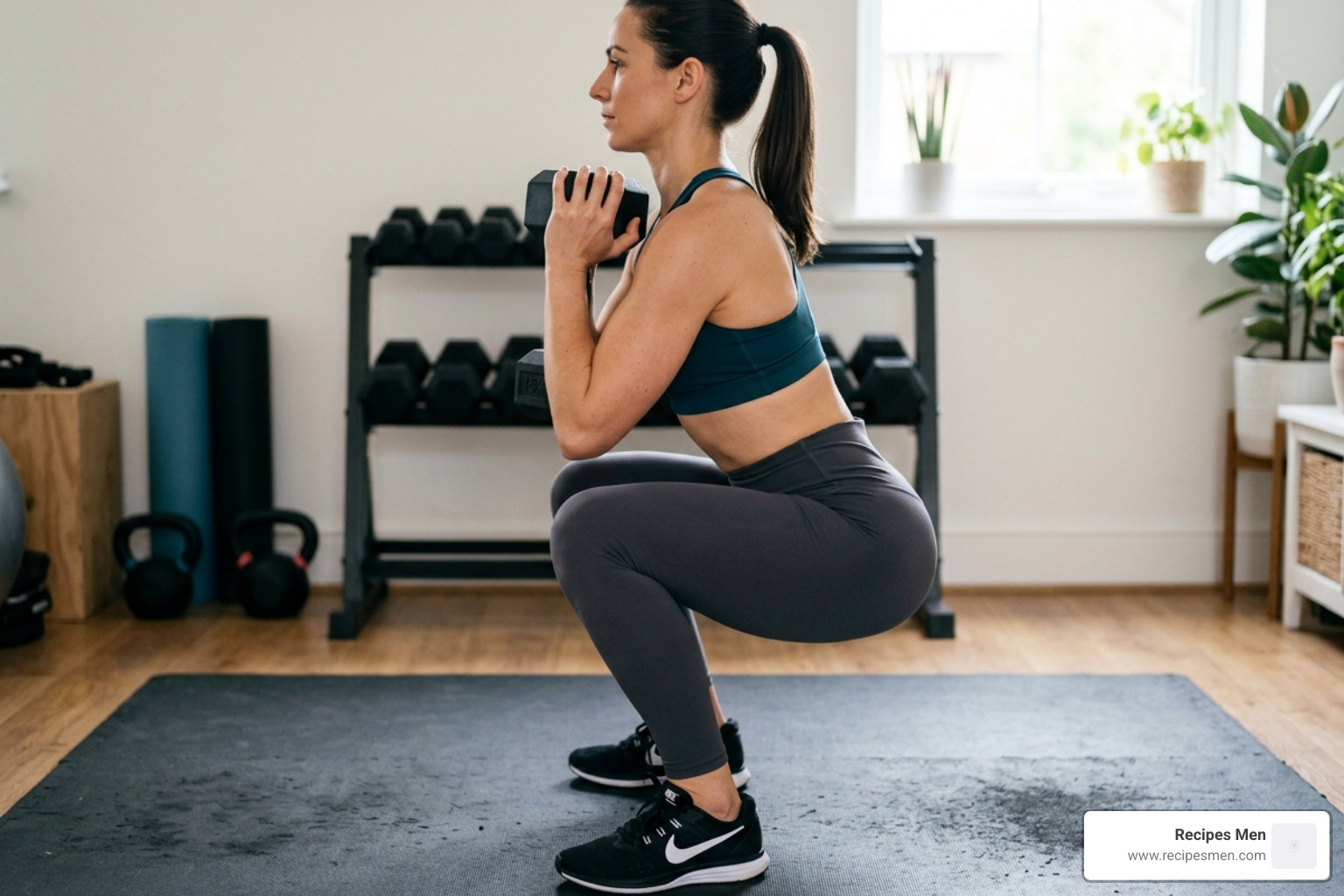
- Goblet Squats: Hold one dumbbell vertically against your chest like a “goblet.” Keep your feet shoulder-width apart, sit your hips back, and lower down until your thighs are parallel to the floor. Drive through your heels to stand back up.
- Romanian Deadlifts (RDLs): Hold dumbbells in front of your thighs. With a slight bend in your knees, hinge at the hips and lower the weights toward your shins while keeping your back flat. You should feel a deep stretch in your hamstrings.
- Forward Lunges: Take a big step forward and lower your back knee toward the ground. Keep your torso upright and ensure your front knee stays in line with your toes.
- Lateral Lunges: Step out to the side, keeping one leg straight while bending the other. This targets the inner and outer thighs and improves lateral stability.
- Calf Raises: Stand with feet hip-width apart and dumbbells at your sides. Rise onto the balls of your feet, squeeze your calves at the top, and lower slowly.
- Step-Ups: Use a sturdy chair or a staircase. Step up with one foot, driving through the heel to bring your other foot up. This is fantastic for glute development.
- Glute Bridges: Lie on your back with knees bent and a dumbbell resting on your hips. Squeeze your glutes to lift your hips toward the ceiling.
Upper Body and Core: Basic Dumbbell Exercises at Home for Total Power
Building a strong upper body isn’t just about aesthetics; it’s about making everyday tasks easier and protecting your posture.
- Overhead Press: Stand tall and press the dumbbells from your shoulders toward the ceiling. This builds powerful shoulders and triceps.
- Bent-Over Rows: Hinge forward at the waist with a flat back. Pull the dumbbells toward your hips, squeezing your shoulder blades together. This is the ultimate “pulling” move for a strong back.
- Dumbbell Floor Press: A beginner-friendly version of the bench press. Lie on the floor and press the weights up. The floor acts as a safety stop, preventing you from overextending your shoulders.
- Bicep Curls: Keep your elbows pinned to your sides and curl the weights toward your shoulders. Avoid using momentum or swinging your body.
- Tricep Kickbacks: Hinge forward and extend your arms back until they are straight. This isolates the back of the arm.
- Lateral Raises: Lift the weights out to the sides with a slight bend in the elbows. This builds that classic shoulder width.
- Weighted Crunches: Hold a light dumbbell against your chest while performing a standard crunch to add extra resistance to your abs.
- Plank Rows (Renegade Rows): Get into a plank position with your hands on the dumbbells. Row one weight up while keeping your hips steady. This is a brutal but effective core and back combo.
How to Structure Your Home Workout Routine
Now that you know the moves, how do you put them together? A Full-Body Dumbbell Workout: 30-Minute Routine is the most efficient way for beginners to see results.
| Feature | Full-Body Routine | Upper/Lower Split |
|---|---|---|
| Frequency | 2-3 times per week | 4 times per week |
| Best For | Beginners & Busy Schedules | Intermediate/Advanced |
| Recovery | 48 hours between sessions | 24-48 hours per muscle group |
| Focus | Efficiency & Compound Moves | Higher Volume & Isolation |
The Golden Rules for Beginners:
- Sets & Reps: Aim for 2-3 sets of 8-12 repetitions for each exercise. If you can easily do 15 reps with perfect form, it’s time to increase the weight.
- Frequency: 3 times per week is the “sweet spot.” This allows for the 48-hour recovery window that muscles need to repair and grow.
- Progressive Overload: This is the most important concept in fitness. To keep getting results, you must gradually make the workout harder by increasing the weight, adding more reps, or decreasing rest time.
- Session Length: Keep it between 30-60 minutes. Anything longer usually leads to “junk volume” where your form starts to slip.
Safety First: Form, Warm-Ups, and Avoiding Mistakes
Before you start swinging weights around, we need to talk about safety. Nothing stalls progress like an injury.
The Dynamic Warm-Up Never lift “cold.” Spend 5-10 minutes doing dynamic movements like arm circles, bodyweight squats, and lunges to get your blood flowing and joints lubricated. Save the static stretching (holding a stretch for 30 seconds) for your cool-down after the workout.
Avoid “Ego Lifting” Ego lifting is trying to move weight that is too heavy for you just to feel strong. It leads to poor form, “cheating” with momentum, and eventually, injury. True strength comes from respecting your body and mastering the technique.
Key Form Cues for Every Move:
- Neutral Spine: Keep your back flat and your neck in line with your spine. Don’t look up at the ceiling or down at your feet.
- Core Engagement: Imagine someone is about to poke you in the stomach. Bracing your core protects your lower back.
- Breathing: Exhale during the “hard” part of the lift (the exertion) and inhale as you lower the weight. Never hold your breath!
- Control: If you can’t control the weight on the way down, it’s too heavy. The lowering phase (eccentric) is actually where a lot of muscle growth happens.
Frequently Asked Questions about Home Dumbbell Workouts
How do I know if my dumbbells are too heavy?
We use the 2-reps-in-reserve rule. By the time you reach the end of your set (say, rep 10), you should feel like you could have done maybe 2 more reps with perfect form, but definitely not 5 more. If your form breaks down—your back arches, your knees cave, or you start swinging—the weight is too heavy. Put it down and grab a lighter pair.
Can I build muscle with just 15 minutes a day?
Absolutely. Consistency is more important than duration. A 15-minute routine done 5 days a week totals 75 minutes weekly, which is significantly better than doing one long workout every two weeks. For a 15-minute session, focus on high-intensity intervals or supersets (doing two exercises back-to-back without rest) to keep your heart rate up and maximize muscle stimulus.
How often should a beginner strength train?
We recommend 2 to 3 sessions per week for absolute beginners. This schedule aligns with muscle protein synthesis, which remains elevated for about 48 to 72 hours after a workout. Training every day as a beginner often leads to burnout or overtraining. Use your “off” days for active recovery—walking, light stretching, or some of our favorite healthy cooking!
Conclusion
Starting a journey with basic dumbbell exercises at home is one of the best investments you can make in yourself. It’s not about having a perfect home gym or lifting the heaviest weights on day one; it’s about showing up, mastering the basic movement patterns, and staying consistent.
At RecipesMen, we believe that fitness and nutrition go hand-in-hand. Once you’ve finished your workout, make sure you’re fueling your recovery with the right nutrients. Building muscle and losing fat is a marathon, not a sprint, and having a plan for both your training and your meals makes that marathon a lot more enjoyable.
Ready to take the next step in your health journey? More info about healthy lifestyle tips can be found on our main site, where we break down everything from protein-packed snacks to mental health strategies for the modern man. Grab those weights, stay hungry for progress, and let’s get to work!

