
How to Survive and Thrive During Your 30 Day Fitness Meal Plan
Why a 30 Day Diet and Workout Plan Is the Best Way to Jumpstart Your Fitness
A 30 day diet and workout plan is one of the most effective ways to build real, lasting fitness habits — and here’s what you need to know upfront:
Quick-start summary:
- Realistic fat loss: Expect 4–8 pounds (about 2–4 kg) over 30 days at a safe, steady pace
- Calorie deficit: Aim for 300–500 fewer calories per day than you burn
- Workout frequency: 4–5 sessions per week mixing strength training, cardio, and active recovery
- Protein target: 1.6–2.2g per kg of body weight daily to protect muscle
- Lifestyle factors: 7–8 hours of sleep, 2–3 liters of water, and stress management all matter as much as your workouts
So you’re a busy guy in your 30s. You want to lose some weight, eat better, and actually stick to a plan this time.
The problem? Most 30-day guides hand you either a brutal workout with zero food guidance, or a crash diet with no training plan. Both fail.
The good news is that 30 days is genuinely enough time to see real changes — not just on the scale, but in how your clothes fit, how you sleep, and how much energy you have by 3pm.
You don’t need to be perfect. You need to be consistent.
This guide gives you both sides of the equation — what to eat and how to train — so they work together instead of against each other.
Setting Realistic Goals for Your 30 Day Diet and Workout Plan

When we start a new journey in April 2026, it’s easy to get swept up in the “shredded in a week” marketing. But let’s keep it real. If you see a program claiming you’ll lose 20 pounds in 30 days, run the other way. While some extreme programs like the 30 Day Shred make big claims, the math usually tells a different story. For example, a 150-pound person might only burn 200–300 calories in a 20-minute high-intensity session. To lose one pound of fat, you need a deficit of roughly 3,500 calories.
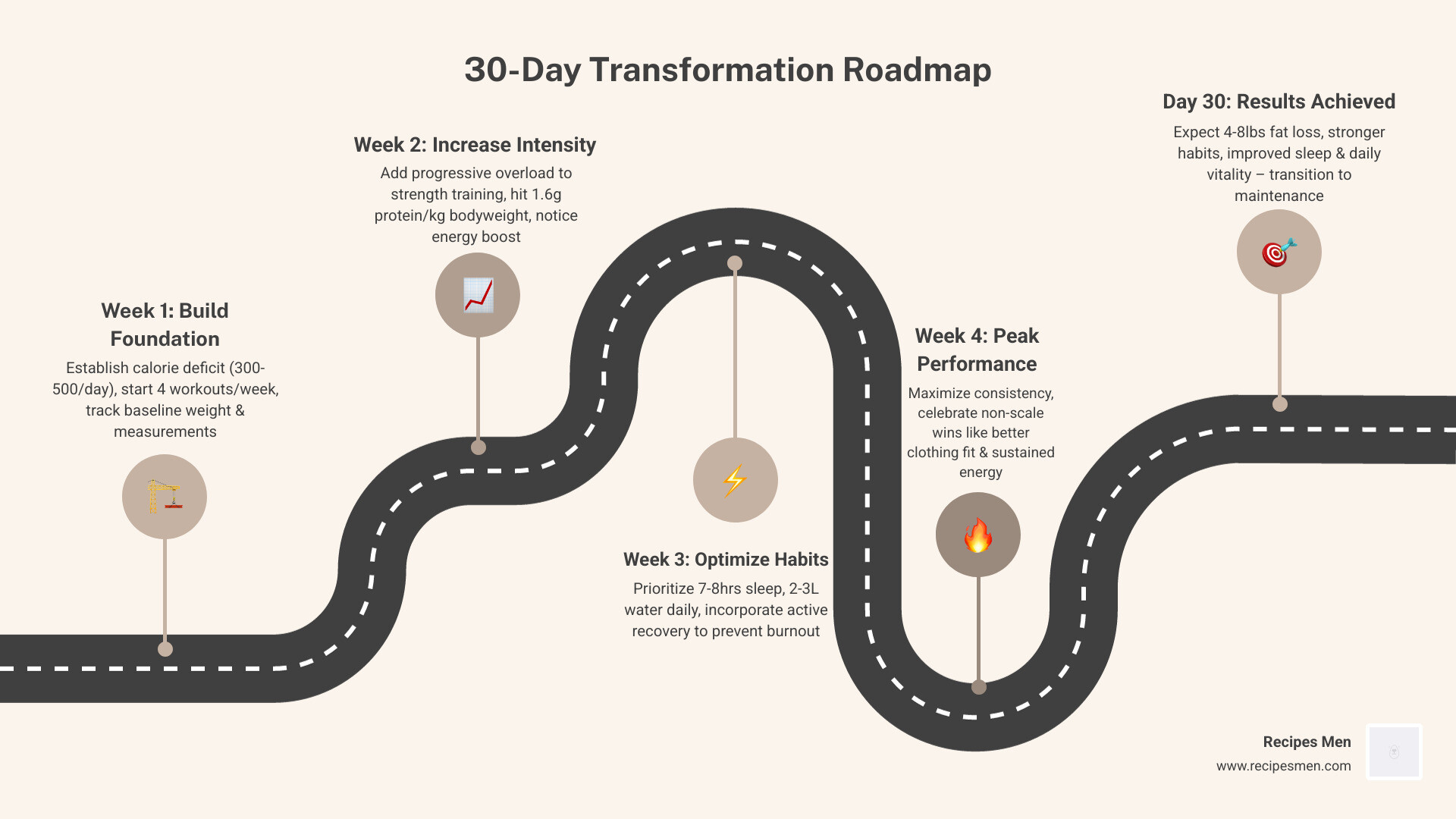
In our experience at Recipes Men, the most successful guys are the ones who aim for “body recomposition.” This is the “magic” phase where you lose fat and gain muscle simultaneously. In 30 days of consistent effort, you can realistically expect to lose 4–8 pounds of fat while potentially gaining 1–2 kg of muscle if you are new to resistance training. You might also see 3–5 cm disappear from your waistline.
According to scientific research on healthy weight loss rates, people who lose weight slowly and steadily (about 1 to 2 pounds per week) are significantly more likely to keep it off long-term.
Calculating Your Caloric Needs
To make your 30 day diet and workout plan work, we need to understand Energy Balance. Your Basal Metabolic Rate (BMR) is what you burn just staying alive, and your Total Daily Energy Expenditure (TDEE) includes your movement.
We recommend a moderate daily deficit of 300 to 500 calories. This is the “sweet spot” because it’s enough to trigger fat loss but not so much that you feel like a zombie or start losing muscle. If your TDEE is 2,500 calories, aiming for 2,000–2,100 calories daily is a sustainable path.
Understanding Body Changes
The scale is a liar—or at least, it doesn’t tell the whole truth. During your first 30 days, your weight might fluctuate wildly due to water retention (especially if you’re starting a new lifting routine) or changes in glycogen stores.
Focus on non-scale victories (NSVs). Does your favorite belt feel looser? Do you have more energy to play with your kids? These are better indicators of success than a number on a piece of plastic in your bathroom. Muscle is denser than fat, so you might look significantly leaner even if the scale hasn’t moved as much as you’d hoped.
The 30-Day Workout Schedule: Strength, Cardio, and Recovery

A balanced 30 day diet and workout plan shouldn’t leave you unable to walk. We want to build you up, not break you down. The goal is to hit about 300 minutes of physical activity per week for optimal weight loss, as suggested by international guidelines.
A solid 30-day workout schedule for weight loss usually follows a 3-2-1 or 4-1-2 structure. This means:
- 3-4 days of Strength Training: Building muscle to boost your resting metabolism.
- 2 days of Cardio: A mix of HIIT (High-Intensity Interval Training) for calorie burn and LISS (Low-Intensity Steady State) for heart health.
- 1-2 days of Active Recovery: Gentle walking, stretching, or yoga to help your muscles repair.
Beginner Exercises for Your 30 Day Diet and Workout Plan
If you’re starting from zero, don’t overcomplicate it. You don’t need fancy machines. Focus on compound movements—exercises that use multiple joints and muscle groups.
- Strength: Bodyweight squats, push-ups (on knees if needed), and lunges.
- Core: Planks and bird-dogs to protect your back.
- Cardio: Walking is the ultimate entry point. We love “walking streaks.” Aim for at least 30 minutes of moderate walking every single day. It’s low-impact, accessible, and incredible for mental health.
- HIIT: 40 seconds of “work” (like jumping jacks or mountain climbers) followed by 20 seconds of rest.
Weekly Progression and Intensity
Progressive overload is the secret sauce. If you do the exact same 10 push-ups for 30 days, your body will stop changing.
- Week 1: Establish your baseline. Learn the form.
- Week 2: Increase the intensity. Maybe add 2 pounds to your dumbbells or walk 5 minutes longer.
- Week 3: Increase volume. Add an extra set to your lifts or reduce your rest time.
- Week 4: Aim for a “Personal Best.” Push yourself to see how far you’ve come since Day 1.
Nutrition Principles: Fueling for Performance and Fat Loss
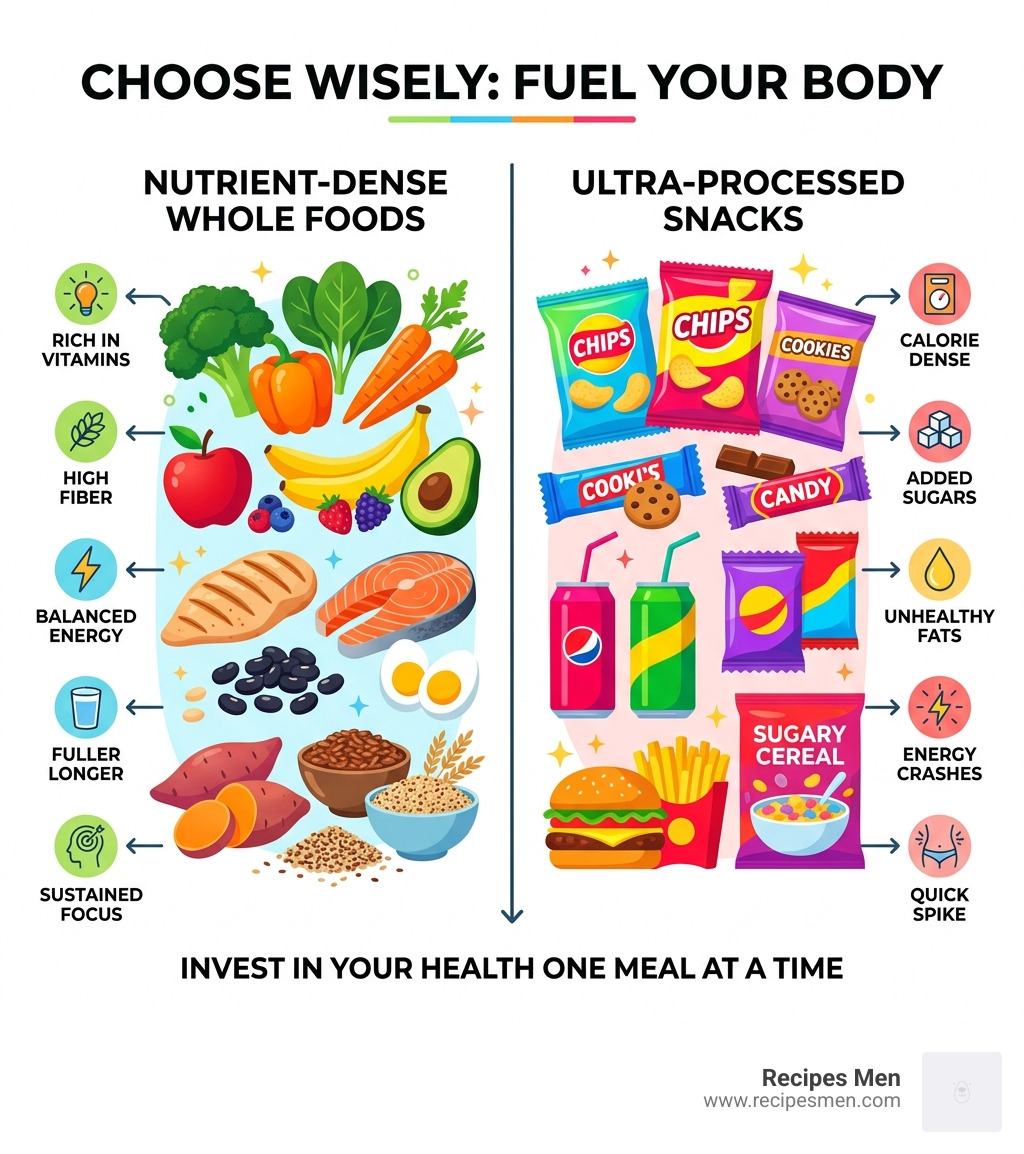
You can’t out-train a poor diet. At Recipes Men, we believe nutrition is about 80% of the battle. We advocate for “Clean Eating”—focusing on minimally processed whole foods rather than restrictive fad diets.
Structuring Your 30 Day Diet and Workout Plan Meals
Think of your plate in quarters:
- Half the plate: Non-starchy vegetables (broccoli, spinach, peppers).
- One quarter: Lean protein (chicken, fish, lean beef, tofu).
- One quarter: Complex carbohydrates (sweet potatoes, quinoa, brown rice).
Protein is your best friend during a 30 day diet and workout plan. It keeps you full and prevents your body from burning muscle for fuel. Aim for roughly 1.6g to 2.2g of protein per kilogram of body weight. For a 180lb man, that’s about 130g–180g of protein daily.
We also swear by the 80/20 rule: Eat clean 80% of the time, and allow yourself a treat for the other 20%. This prevents the “all-or-nothing” mentality that leads to weekend binges. For more healthy meal ideas, check out our latest recipes designed specifically for guys who want flavor without the fluff.
Budget-Friendly Meal Prepping
Healthy eating doesn’t have to be expensive. You can actually “ball on a budget” and finish a full week of meal prep for around $75.
- Bulk Buy: Get your proteins (like chicken breast or ground turkey) in large packs.
- Frozen is Fine: Frozen vegetables are often just as nutritious as fresh ones and much cheaper.
- The Sunday Ritual: Spend two hours on Sunday cooking your grains and proteins. If you have healthy food ready in the fridge, you won’t reach for the delivery app when you’re tired on Wednesday night.
Maximizing Results Through Lifestyle and Recovery
You don’t get fit in the gym; you get fit while you sleep. Research shows that people sleeping less than seven hours per night are more likely to struggle with obesity. Poor sleep spikes cortisol (the stress hormone) and makes you crave high-fat, high-sugar snacks.
According to research on sleep and obesity risk, recovery is just as important as the training itself. If you aren’t recovering, you aren’t growing.
The Role of Hydration and Electrolytes
Most of the time when you think you’re hungry, you’re actually just thirsty. Drinking 8–10 cups of water daily (about 2–3 liters) is non-negotiable. Water aids in digestion, keeps your joints lubricated, and can even boost your metabolism. If you’re doing heavy HIIT sessions, consider adding a pinch of sea salt or an electrolyte powder to your water to prevent muscle cramps.
Managing Stress and Mental Health
Stress is a silent progress-killer. High stress levels lead to emotional eating and poor workout performance. We recommend incorporating small “mental health wins” into your 30 day diet and workout plan. This could be a 5-minute meditation, listening to a podcast during your walk, or joining a community for accountability. Knowing you aren’t doing this alone makes a massive difference.
Frequently Asked Questions about 30-Day Plans
How much weight can I realistically lose in 30 days?
As we mentioned, a healthy and sustainable rate is 1–2 pounds per week. Over 30 days, that is 4–8 pounds. While some might lose more (especially if they have a higher starting weight), this range ensures you are losing fat rather than just water or muscle.
Do I need a gym membership for this plan?
Absolutely not. While a gym offers more equipment, you can achieve incredible results at home with just your body weight, a set of dumbbells, or resistance bands. The “best” workout is the one you actually do, whether that’s in a fancy gym or your garage.
What should I do after the 30 days are over?
Don’t stop! Use the 30 days as a “launchpad.” Transition into a maintenance phase where you slightly increase your calories but keep the workout habits you’ve built. The goal is to turn this 30 day diet and workout plan into a lifelong lifestyle. Habit stacking—adding one new healthy habit each week—is the best way to ensure you don’t rebound.
Conclusion
Starting a 30 day diet and workout plan is a commitment to yourself. It’s about more than just looking better in April 2026; it’s about feeling stronger, sleeping better, and having the energy to live your life to the fullest.
At Recipes Men, we are here to provide the straightforward, flavorful fuel you need to keep going. Remember to consult with a doctor before starting any new intensive exercise program, especially if you have underlying health conditions.
Are you ready to transform? Start your 30-day journey today and let’s get to work. Consistency over perfection, every single time.

