
Gym Routines to Beat Stress: Flexing on Your Frustrations
Why Gym Routines Beat Stress (And What to Do About It)
Gym routines beat stress more effectively than most people realize — and the science backs it up.
Here’s a quick snapshot of the best gym workouts for stress relief:
| Workout Type | Stress-Relief Benefit | Time Needed |
|---|---|---|
| HIIT | Rapid endorphin release, burns off cortisol | 20-30 min |
| Strength training | Builds confidence, interrupts anxious thoughts | 30-45 min |
| Yoga / stretching | Calms the nervous system, reduces tension | 20-40 min |
| Rhythmic cardio | Clears mental fog, boosts mood | 30 min |
| Boxing / bag work | Releases pent-up energy, sharpens focus | 20-30 min |
The bottom line: Aim for at least 150 minutes of moderate exercise per week. Even a single 10-minute walk can begin lifting your mood right away.
Stress is a normal part of life. But how you respond to it makes all the difference.
When stress hits, your body triggers a fight-or-flight response — flooding your system with cortisol and adrenaline. That’s useful in a real emergency. But when it happens every day over a work email or a packed schedule, those stress hormones just sit in your body and cause damage.
That’s where the gym comes in.
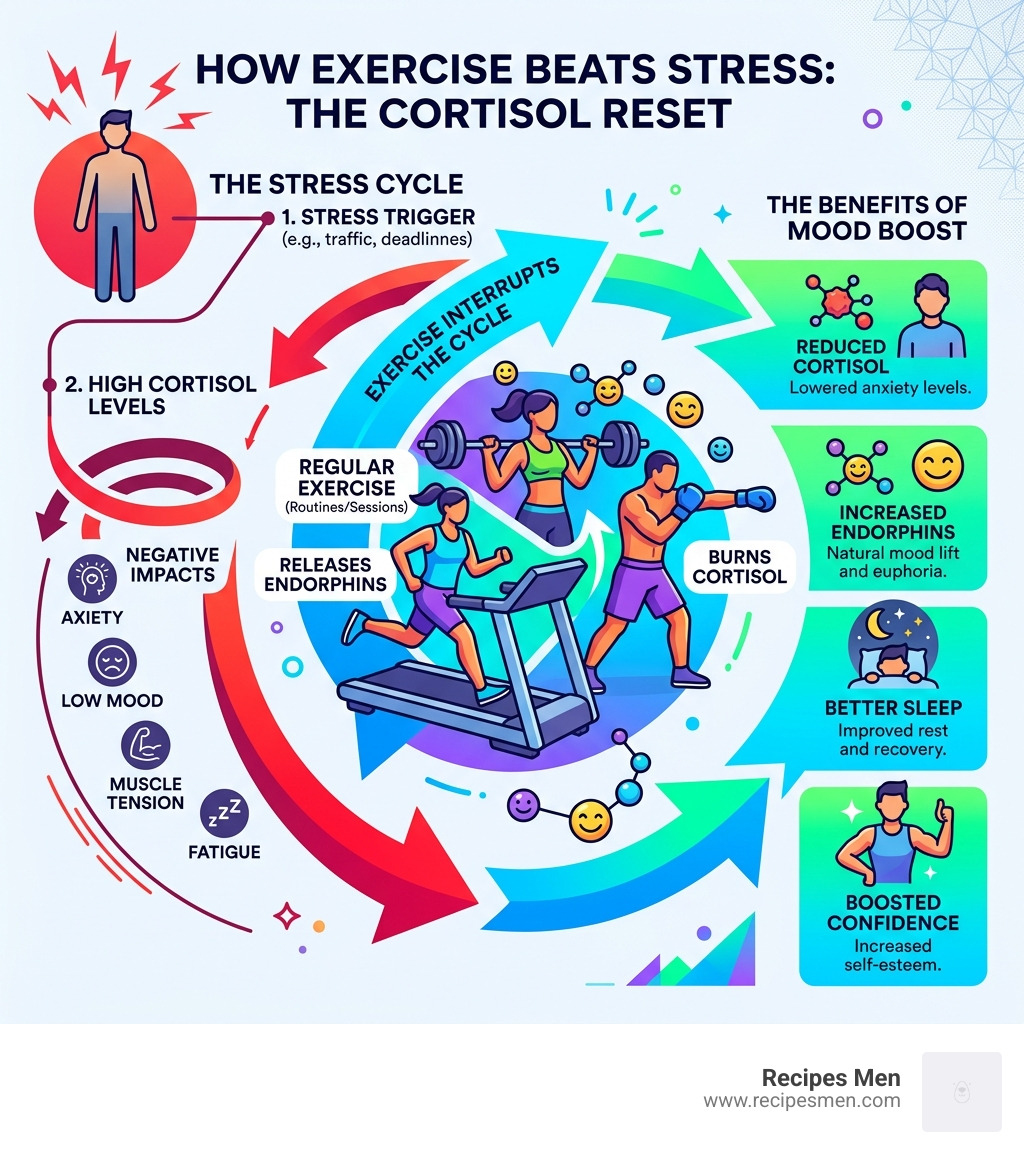
Exercise gives those stress chemicals somewhere to go. It burns off cortisol, releases feel-good endorphins, and trains your brain to handle pressure better over time. Research from a meta-analysis of over 1.2 million adults found that people who exercised regularly had 43% fewer days of poor mental health per month compared to those who didn’t.
And here’s the part most guys overlook: you don’t need an intense two-hour session to feel the benefits. About five minutes of aerobic exercise is enough to start triggering anti-anxiety effects. Even a short walk counts.
Whether you’re dealing with work pressure, family demands, or just the low-level hum of modern life, building a simple gym routine could be one of the most powerful things you do for your mental health in 2026.
The Science of Sweat: Why Gym Routines Beat Stress
We often think of the gym as a place to build bigger biceps or drop a few pounds, but the most important muscle you’re training is between your ears. When we say gym routines beat stress, we aren’t just using a catchy slogan. There is a profound physiological transformation happening every time you pick up a dumbbell or hit the treadmill.
The Neurochemical Reset
First, let’s talk about the “feel-good” chemicals. When you engage in vigorous physical activity, your brain releases endorphins—your body’s natural painkillers and mood elevators. These chemicals interact with the receptors in your brain that reduce your perception of pain and trigger a positive feeling in the body, similar to that of morphine.
But it’s not just about adding the good stuff; it’s about clearing out the bad. Chronic stress keeps your cortisol levels—the primary stress hormone—elevated. High cortisol is linked to weight gain, sleep issues, and anxiety. Exercise helps “metabolize” this excess cortisol. Think of it like a pressure valve: the gym allows you to vent that built-up hormonal steam so it doesn’t scald your internal systems.
Cross-Stressor Adaptation
One of the coolest concepts we’ve found in our research is “cross-stressor adaptation.” This theory suggests that if you regularly subject your body to the “stress” of a workout, your body becomes better at handling all types of stress.
When you’re under a heavy squat bar, your heart rate climbs, your breathing quickens, and your body enters a controlled state of stress. By navigating this in the gym, you are essentially “practicing” your stress response. Later, when a stressful work deadline hits in April 2026, your nervous system doesn’t panic. It says, “I’ve been here before,” and keeps you calm. This is a fundamental way How To Improve Your Mental Health Without Losing Your Mind—by building physical resilience that translates to mental grit.
Neuroplasticity and Resilience
Regular exercise also promotes neuroplasticity—the brain’s ability to form new neural connections. It increases the production of Brain-Derived Neurotrophic Factor (BDNF), a protein that supports the survival of existing neurons and encourages the growth of new ones. In simple terms, exercise helps “rewire” your brain to be less reactive to stress.
If you’re a “weekend warrior” who can’t find time during the week, don’t worry. Research shows that 4 weekend workouts eliminate anxiety without drugs by providing concentrated doses of these neurochemical benefits, helping you process the week’s frustrations in one go.
Top Gym Workouts for Immediate Mental Relief
Not all workouts are created equal when it comes to smashing stress. While any movement is better than sitting on the couch, some gym routines beat stress with surgical precision.

High-Intensity Intervals and Boxing
If you’ve had a day where you just want to punch something, boxing or High-Intensity Interval Training (HIIT) is your best friend.
- Catharsis: There is a genuine emotional release found in hitting a heavy bag. It allows you to externalize your internal frustrations in a safe, productive environment.
- The Endorphin Spike: Because HIIT pushes your heart rate into the upper zones, the subsequent “endorphin high” is usually much more intense than what you’d get from a casual stroll.
- Mental Focus: It is nearly impossible to worry about your mortgage or your boss when you are trying to survive a 30-second sprint or a complex punching combination. This “meditation in motion” forces you into the present moment.
Strength Training and Mindful Movement
Lifting weights isn’t just about vanity; it’s about “self-efficacy.” Every time you add five pounds to the bar, you are proving to yourself that you can overcome challenges.
- Progressive Overload: This isn’t just a muscle-building principle; it’s a mental one. By mastering the basics, like you can with these Essential Home Dumbbell Moves, you build a sense of mastery that carries over into your life.
- Mind-Body Connection: Strength training requires you to focus on your form, your breathing, and the sensation of the muscle contracting. This groundedness is the perfect antidote to the “racing thoughts” associated with anxiety.
For those who prefer a more structured approach, we often look at diverse plans. Even though it’s labeled for a different demographic, the principles in a 5-Day Build & Sweat Gym Workout Plan for Women show how balancing strength and cardio can create a holistic sense of well-being.
If you don’t have a gym membership yet or prefer the freedom of movement, you can Master Your Own Weight With This Bodyweight Calisthenics Routine. Calisthenics movements like push-ups and pull-ups mimic real-life movements and provide a functional strength that makes daily life feel less physically taxing—and therefore, less stressful.
Designing Your Weekly Schedule for 2026
Consistency is the secret sauce. A single workout will make you feel better for a few hours, but gym routines beat stress long-term only if you stick to them. As we look at the fitness landscape in April 2026, the emphasis is on “sustainability over intensity.”
The 150-Minute Rule
Federal guidelines and health experts generally agree on a baseline for stress management. We’ve broken it down for you here:
| Activity Level | Weekly Requirement | Example Schedule |
|---|---|---|
| Moderate Intensity | 150 Minutes | 30 mins of brisk walking or light cycling, 5 days a week |
| Vigorous Intensity | 75 Minutes | 25 mins of HIIT or heavy lifting, 3 days a week |
| Hybrid Approach | Mix of both | 2 days of lifting + 2 days of brisk walking |
SMART Goals for Stress Relief
Don’t just say “I want to be less stressed.” Use SMART goals:
- Specific: “I will go to the gym for 30 minutes.”
- Measurable: “I will go 3 times this week.”
- Achievable: Don’t plan a 2-hour workout if you only have 40 minutes.
- Relevant: Choose exercises you actually enjoy. If you hate running, don’t run!
- Time-bound: “I will stick to this for the next 4 weeks.”
If you’re tight on time, you can even Master An Easy 30 Minute Workout At Home on the days you can’t make it to the gym.
Common Mistakes to Avoid
- Overtraining: More is not always better. If you push too hard without rest, you actually increase your cortisol levels, making stress worse.
- Comparison Trap: Your gym routine is for your brain, not for Instagram. Don’t stress yourself out trying to match someone else’s lifting numbers.
- Ignoring Nutrition: You can’t out-train a bad diet. Stress often leads to “stress eating,” but fueling your body correctly helps stabilize your mood.
A Simple Beginner-Friendly Gym Routine to Beat Stress
If you’re just starting out in April 2026, don’t overcomplicate it. Here is a “Stress-Reset” routine you can do anywhere:
- 5-Minute Warm-up: Brisk walk on the treadmill or around the block.
- Bodyweight Circuit (3 rounds):
- 15 Bodyweight Squats (Focus on your breath)
- 10 Push-ups (Against a wall or on knees if needed)
- 20-second Plank (Focus on core stability)
- 10 Alternating Lunges
- 10 Minutes of Rhythmic Cardio: A steady pace on a bike or rower where you can still hold a conversation.
- Cool Down: 5 minutes of light stretching.
To help transition into a restful state after a workout, we highly recommend checking out Evening Stretch Routines Knot Your Average Bedtime Ritual. It’s the perfect way to signal to your nervous system that the “work” is done and it’s time to recover.
How Quickly Can Gym Routines Beat Stress?
You’ll be happy to know the “ROI” on exercise is incredibly fast:
- 5 Minutes: You’ll start to feel an anti-anxiety effect as your heart rate rises and blood flow to the brain increases.
- Post-Workout: For 90 to 120 minutes after your session, you’ll likely experience a “calm-down” period where your blood pressure is lower and your mood is elevated.
- 4 Weeks: This is the magic window for habit formation. By this point, your body has begun to adapt, and you’ll start noticing that “daily irritations” don’t get under your skin as much.
- Long-Term: Over months and years, regular gym routines can actually lead to structural changes in the brain (like a larger hippocampus), which significantly improves your long-term emotional regulation.
Recovery: The Backbone of Mental Resilience
We like to say that you don’t get stronger in the gym; you get stronger while you recover from the gym. If you aren’t prioritizing rest, your gym routines beat stress efforts will hit a wall.

The Role of Nutrition
When you’re stressed, your body burns through nutrients faster. B vitamins, magnesium, and vitamin C are all depleted during high-stress periods. Proper meal prep ensures that you have the fuel to recover and the nutrients to keep your brain happy.
For example, if you’ve had a heavy session, using The Best Leg Day Meal Prep Strategies For Serious Gains isn’t just about building muscle; it’s about giving your body the complex carbs and proteins it needs to stabilize blood sugar and prevent those “hangry” mood swings that lead to more stress.
Parasympathetic Activation
Your nervous system has two main modes: Sympathetic (Fight or Flight) and Parasympathetic (Rest and Digest). Gym routines are sympathetic. To balance the scales, you must spend time in the parasympathetic mode.
One of the most effective ways to do this is through Mastering The Art Of Progressive Muscle Relaxation. This technique involves tensing and then releasing different muscle groups, which teaches your brain to recognize and “let go” of physical tension. It’s a game-changer for guys who carry stress in their shoulders or jaw.
Sleep Hygiene
Sleep is the ultimate recovery tool. Regular exercise generally improves sleep quality, but you can help the process by:
- Stopping vigorous exercise at least 2-3 hours before bed.
- Keeping your bedroom cool and dark.
- Using a “brain dump” journal to write down tomorrow’s tasks so they don’t keep you awake.
Conclusion
At RecipesMen, we believe that fitness is about more than just a physique—it’s about a lifestyle that supports your total well-being. We’ve seen how gym routines beat stress, transforming overwhelmed guys into resilient, focused versions of themselves.
Whether you’re hitting a heavy bag to vent frustration, lifting weights to build confidence, or taking a long walk to clear your head, you are taking an active role in your mental health. Consistency beats intensity every time. Start small, find a routine you actually enjoy, and don’t forget to fuel your body with the right nutrients to keep that stress at bay.
You have the tools, the science, and the plan. Now, it’s time to hit the gym and start flexing on your frustrations.
Master your health and stress levels today by exploring our full range of recipes and workout guides!

